




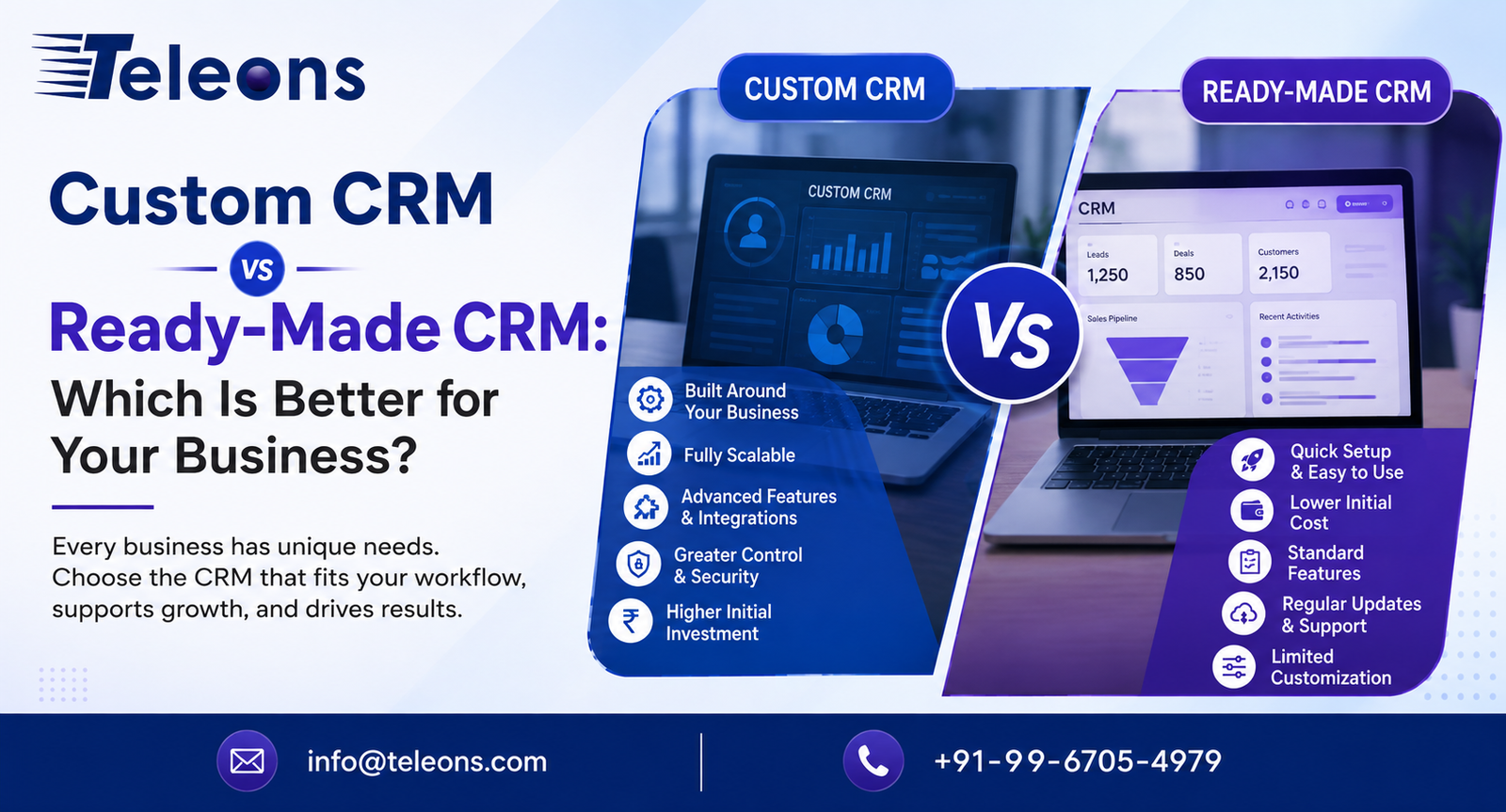
Customer relationships are at the center of every growing business. As the number of leads, customers, sales activities, and follow-ups increases, managing customer information through spreadsheets or disconnected tools can become difficult. A Customer Relationship Management (CRM) system helps businesses organize customer data, manage sales pipelines, automate tasks, and improve communication.
However, businesses often face an important decision: Should you choose a ready-made CRM or invest in custom CRM development?
Both options have advantages. The right choice depends on your business size, processes, budget, integration requirements, scalability goals, and the level of customization you need.
What Is a Ready-Made CRM?
A ready-made CRM is a pre-built software solution designed to serve a wide range of businesses. It generally includes standard features such as contact management, lead tracking, sales pipelines, task management, reporting, email integration, and customer communication.
Because the software is already developed, businesses can usually start using it much faster than a custom-built system. This makes ready-made CRM solutions attractive to companies that need standard CRM functionality without a lengthy development process.
However, businesses may need to adjust their workflows to fit the CRM’s available features.
What Is a Custom CRM?
A custom CRM is developed specifically around the requirements and workflows of a particular business. Instead of changing business processes to match existing software, the CRM can be designed around how the company actually operates.
A custom CRM can include specialized modules, custom dashboards, unique automation workflows, third-party integrations, role-based access, industry-specific functionality, and other features that may not be available in standard CRM platforms.
This approach can be particularly useful for businesses with complex or highly specialized processes.
Custom CRM vs Ready-Made CRM: Key Differences
Customization
Customization is one of the biggest differences between the two options.
Ready-made CRMs typically offer configuration options, plugins, extensions, and integrations. However, businesses are generally limited by the platform’s capabilities.
A custom CRM can be designed around specific workflows, fields, processes, permissions, dashboards, and business requirements.
Implementation Time
A ready-made CRM usually has a shorter implementation period because the core software has already been developed.
Custom CRM development takes more time because the system must be planned, designed, developed, tested, and deployed according to the organization’s requirements.
Businesses should therefore consider whether they need a quick solution or are willing to invest time in building a system specifically for their operations.
Cost
The initial cost of a ready-made CRM can be lower because development has already been completed. However, businesses may have recurring subscription costs, paid add-ons, user-based charges, and customization expenses.
A custom CRM generally requires a larger initial investment because it involves software development. However, businesses have greater control over the functionality and can avoid paying for features they do not need.
The total cost should therefore be evaluated over the long term rather than comparing only the initial price.
Scalability
Ready-made CRMs can work well for businesses whose processes fit within the platform’s capabilities. As requirements grow, businesses may need additional plans, integrations, or third-party tools.
A custom CRM can be developed with future expansion in mind. New modules and workflows can be added as business requirements evolve.
Integration
Modern businesses often use multiple systems for accounting, marketing, customer support, inventory, communication, payment processing, and other operations.
Ready-made CRMs may provide integrations with popular third-party applications. However, integrating with a specialized or internally developed system may require additional development.
With a custom CRM, integrations can be planned according to the organization’s technology ecosystem.
User Experience
A ready-made CRM generally follows a standardized interface designed for a broad user base. Businesses may need to train employees to follow the platform’s workflow.
A custom CRM can be designed around the actual roles and processes of the employees who will use it. This can make the system more closely aligned with internal operations.
Data and Control
With a custom CRM, businesses can define how information is structured, how users access different data, and how workflows operate.
Ready-made platforms also provide security and access-control features, but businesses remain dependent on the provider’s infrastructure, policies, updates, and product roadmap.
Advantages of a Ready-Made CRM
A ready-made CRM may be a suitable choice when a business:
Needs a CRM quickly
Has standard sales and customer management requirements
Wants predictable initial implementation
Prefers an established software platform
Needs commonly available integrations
Has a limited development budget
For many small and medium-sized businesses with straightforward workflows, a ready-made CRM can provide everything needed to manage customer relationships effectively.
Advantages of a Custom CRM
A custom CRM can be a better option when a business:
Has unique operational workflows
Requires specialized functionality
Needs extensive third-party integrations
Wants complete control over the system
Handles complex customer or sales processes
Needs highly specific dashboards and reports
Expects significant growth or process expansion
The biggest advantage is flexibility. The system can be built around the organization’s requirements instead of forcing employees to work around a generic workflow.
When Should You Choose a Ready-Made CRM?
A ready-made CRM is often appropriate when your business processes are relatively standard and you need a solution that can be implemented quickly.
For example, a company that primarily needs contact management, lead tracking, sales pipeline management, follow-up reminders, and basic reporting may not need a fully custom system.
A ready-made solution can provide these capabilities without requiring a complete software development project.
When Should You Choose a Custom CRM?
Custom CRM development becomes more attractive when standard platforms cannot efficiently support your business processes.
If employees are constantly using spreadsheets, manual workarounds, multiple disconnected systems, or complex processes to manage customer information, a custom CRM may provide a more efficient solution.
Businesses should also consider custom development when they require specialized integrations, unique automation, complex permissions, or a CRM that will become a core part of their technology infrastructure.
How to Decide Which CRM Is Right for Your Business
Start by documenting your current customer-management workflow. Identify how leads enter your system, how sales teams follow up, how customer information is stored, which tasks are automated, and what reports management requires.
Next, separate your requirements into essential, useful, and optional features. This makes it easier to determine whether an existing CRM can meet your needs.
You should also evaluate implementation time, long-term costs, integrations, scalability, security, employee adoption, and future business requirements.
The goal should not be to choose the most feature-rich CRM. Instead, choose the solution that best supports your actual business processes.
Can a Business Start With a Ready-Made CRM and Later Move to Custom Software?
Yes. Some businesses begin with a ready-made CRM and move toward custom development as their requirements become more complex.
This approach can allow a growing company to start managing customer data quickly while learning which workflows and features are genuinely important.
However, businesses should plan their data structure and integrations carefully if they expect to migrate to another platform in the future.
Why Choose Teleons for Custom CRM Development?
Choosing the right development partner is important when a CRM needs to be built around unique business requirements.
Teleons can help businesses plan and develop customized software solutions based on their workflows, operational requirements, integrations, and growth objectives.
A custom CRM should do more than store customer information. It should help businesses streamline processes, reduce repetitive work, improve visibility, and give teams better access to the information they need.
Conclusion
There is no universal answer to whether a custom CRM or ready-made CRM is better. A ready-made CRM can be an excellent option for businesses with standard requirements that want quick implementation and established functionality.
A custom CRM can be more suitable for businesses with specialized workflows, complex integrations, unique requirements, and long-term scalability needs.
Before making a decision, businesses should evaluate their current processes, budget, technology requirements, future goals, and expected growth.
The best CRM is ultimately the one that fits your business—not the one with the longest feature list.
Need a CRM Designed Around Your Business?
Don’t force your business workflows into a generic system. Teleons can help you plan and develop custom CRM software designed around your specific processes, integrations, automation requirements, and growth goals.
Contact Teleons today to discuss your custom CRM development requirements and build a solution that works the way your business works.
Company Name: Teleons
Website: https://teleons.com/
Phone: +91-99-6705-4979
Email: info@teleons.com
Frequently Asked Questions
1. What is the difference between a custom CRM and a ready-made CRM?
A ready-made CRM is pre-built for a broad range of businesses, while a custom CRM is developed specifically around an organization’s workflows, requirements, integrations, and business processes.
2. Is a custom CRM more expensive than a ready-made CRM?
A custom CRM usually requires a higher initial investment because it involves development. However, the overall cost should be evaluated based on long-term requirements, maintenance, subscriptions, integrations, and scalability.
3. Which CRM is better for a small business?
A ready-made CRM may be suitable for a small business with straightforward customer-management requirements. A custom CRM may become valuable if the business has specialized processes or expects significant operational complexity.
4. How long does it take to develop a custom CRM?
The development timeline depends on the number of features, integrations, complexity, design requirements, testing, and deployment needs. A simple CRM will generally require less development than a large enterprise platform.
5. Can a custom CRM integrate with other business software?
Yes. A custom CRM can be designed to integrate with relevant business systems such as accounting software, marketing platforms, communication tools, payment systems, websites, or internal applications.
6. Is a ready-made CRM easier to implement?
Generally, yes. Since the core software is already developed, implementation can often begin faster than with a completely custom CRM.
7. Can a custom CRM scale with a growing business?
Yes. A custom CRM can be architected with future expansion in mind, allowing additional modules, users, integrations, workflows, and features to be added as business requirements change.
8. How do I know if my business needs a custom CRM?
Consider custom CRM development if your existing CRM cannot support important workflows, requires extensive workarounds, lacks necessary integrations, or limits your ability to scale and automate business processes.


Related Posts
Automate Repetitive Tasks With Custom Software
Introduction Every business has routine tasks that need to be completed daily, from managing customer enquiries and sending emails to updating records, scheduling appointments, and…
Read More
App Store Optimization: How to Get More App Downloads
Building a mobile app is only the first step. The next challenge is getting people to discover, download and use it. With thousands of apps…
Read More