




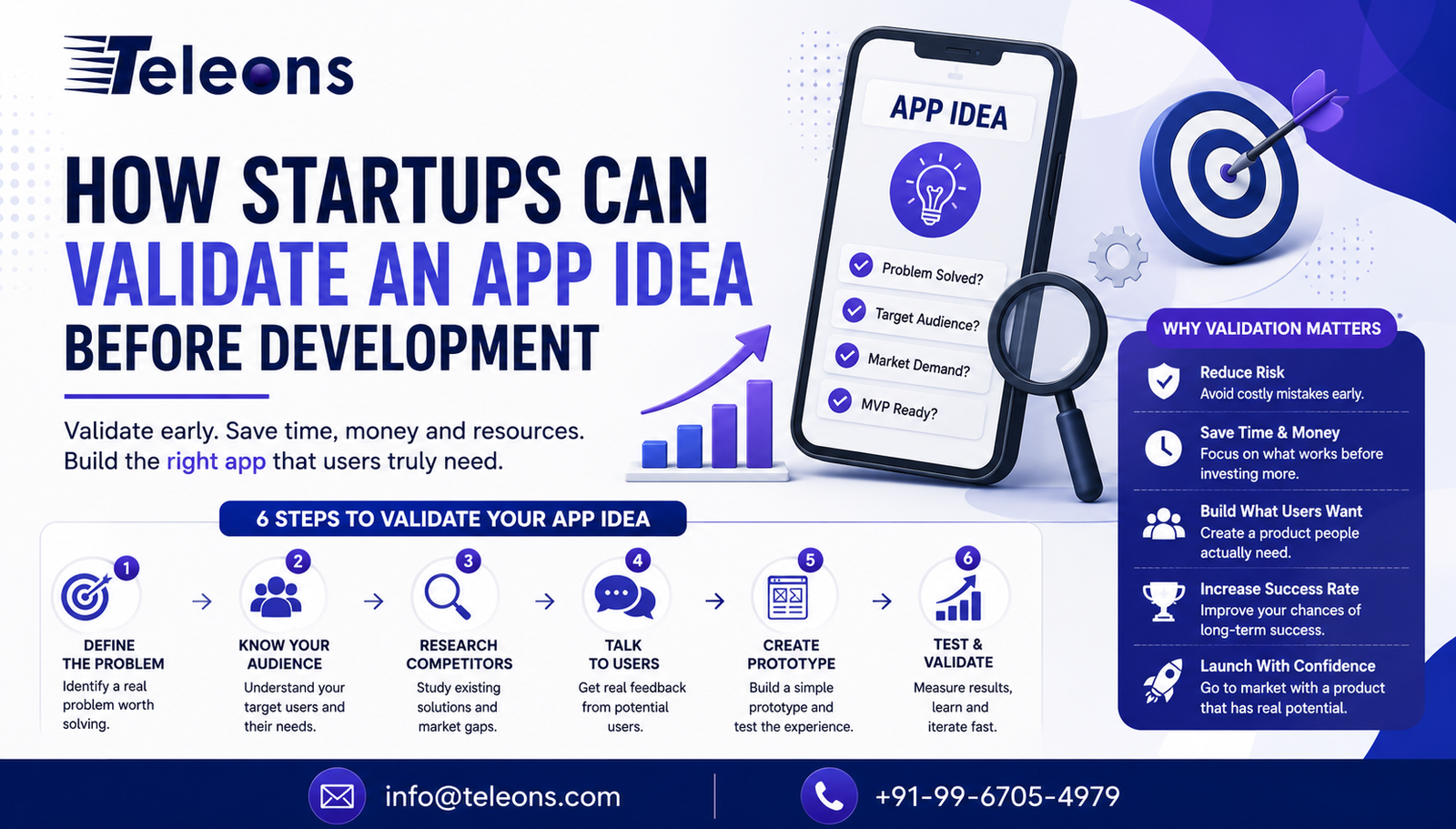
Building an app requires time, money, technical resources, and ongoing maintenance. For startups, investing all these resources into an untested idea can be risky. A great app concept is not necessarily a successful business unless people actually need it and are willing to use or pay for it.
That is why app idea validation should happen before development begins.
Validation helps startups understand whether their idea solves a genuine problem, who the target users are, what features they actually need, and whether there is enough market demand to justify development.
What Is App Idea Validation?
App idea validation is the process of testing a mobile or web app concept with potential users and market evidence before investing significantly in development.
Instead of immediately building a complete application, startups first test assumptions about:
The problem
Target audience
Market demand
Proposed solution
Key features
Pricing
User experience
Business model
The objective is simple: learn what works before spending heavily on development.
Why Should Startups Validate an App Idea?
Many startups focus on building an app as quickly as possible. However, development speed does not guarantee product-market fit.
Validating an idea can help startups:
Reduce Development Risk
Early testing can reveal whether the problem is significant enough for users to seek a solution.
Understand the Target Audience
Validation helps identify who is most likely to use the application and what matters to them.
Prioritize Features
Instead of building dozens of features, startups can identify the functionality users consider most valuable.
Save Development Costs
Discovering a major problem before development is generally easier and less expensive than rebuilding an application after launch.
Improve the Business Model
Market feedback can help startups refine pricing, monetization and customer acquisition strategies.
Clearly Define the Problem
Start by describing the problem your app intends to solve.
Avoid vague statements such as:
“We want to create a better shopping app.”
Instead, identify a specific user problem:
“Small retailers struggle to track customer orders across multiple messaging channels.”
A clearly defined problem makes it easier to determine whether your proposed application provides meaningful value.
Ask yourself:
What problem are we solving?
Who experiences this problem?
How frequently does it occur?
How are people solving it today?
Why are existing solutions insufficient?
If the problem isn’t important to the target audience, even a technically excellent app may struggle.
Identify Your Target Users
Your app shouldn’t be designed for “everyone.”
Create a specific description of your ideal user.
Consider:
Age group
Occupation
Location
Business type
Digital habits
Problems
Goals
Purchasing behavior
For example, instead of targeting “business owners,” you could target “small e-commerce businesses that manage fewer than 100 orders per day.”
A narrower audience can make validation and early marketing much more focused.
Research Existing Competitors
Before building an app, find out what alternatives already exist.
Search app stores, websites, social media and industry platforms for competing products.
Study:
Features
Pricing
User reviews
Ratings
Complaints
Strengths
Weaknesses
Customer segments
Negative reviews can be particularly useful because they reveal problems users already experience with existing solutions.
Your goal isn’t necessarily to create something completely new.
You need to identify why users would choose your product instead of an existing alternative.
Talk to Potential Users
One of the most effective ways to validate an app concept is through direct conversations with potential users.
Ask open-ended questions such as:
What is the biggest challenge you face with this process?
How do you currently solve it?
What frustrates you about existing solutions?
How often do you experience this problem?
What would an ideal solution look like?
Would you consider paying for a solution?
Avoid asking questions designed to confirm your idea.
For example:
“Would you use an app like this?”
may produce overly positive responses.
Instead, ask:
“How do you currently solve this problem?”
This can reveal whether the problem actually exists in users’ everyday lives.
Create a Simple Landing Page
You don’t always need a working app to test demand.
Create a landing page explaining:
The problem
Your proposed solution
Key benefits
Target audience
Main features
Call to action
The CTA could be:
Join the waitlist
Request early access
Book a demo
Sign up for updates
Register for beta testing
Then drive relevant visitors to the page through social media, communities, advertising or your existing network.
The response can provide useful evidence about interest in the concept.
Build an MVP Instead of a Full Application
If initial research indicates strong potential, build a Minimum Viable Product (MVP).
An MVP contains only the essential functionality required to solve the core problem.
For example, if your idea is a food-ordering application, you may initially need:
User registration
Restaurant/product listing
Search
Cart
Ordering
Payment
Basic order tracking
You may not need advanced loyalty programs, AI recommendations, complex dashboards and dozens of additional features in the first version.
The goal is to test the core value proposition, not build the final product immediately.
Create a Prototype Before Development
A clickable prototype can help test the user experience before writing production code.
A prototype can demonstrate:
Navigation
Screens
Buttons
User flows
Forms
Checkout processes
Core interactions
Give the prototype to potential users and observe how they navigate it.
Look for:
Confusion
Unexpected behavior
Missing information
Difficult navigation
Unnecessary steps
Fixing UX problems at the prototype stage is usually easier than fixing them after development.
Test Your Pricing Model
An app can attract users but still fail as a business if its monetization strategy doesn’t work.
Depending on your product, consider:
Subscription
One-time payment
Freemium
Commission
In-app purchases
Advertising
B2B licensing
Don’t simply ask users whether they would pay.
Test actual willingness to pay through:
Early-access offers
Pre-orders
Paid pilots
Subscription trials
Pricing experiments
Real behavior can provide stronger validation than opinions alone.
Define Your Validation Metrics
Before testing your idea, decide what success looks like.
Possible metrics include:
Landing-page sign-ups
Waitlist registrations
Prototype completion rate
Demo requests
Pre-orders
Trial registrations
Customer interviews
MVP retention
Conversion rate
Customer acquisition cost
Your benchmarks should be based on your specific market and business model rather than arbitrary numbers.
Build, Measure and Improve
Validation isn’t a one-time activity.
After launching an MVP, collect feedback and monitor actual user behavior.
Identify:
Which features users use most
Where users stop
Which problems remain unresolved
What users request
Why users leave
Whether customers are willing to pay
Then use this information to improve the product.
This creates a continuous cycle:
Idea → Research → Prototype → MVP → User Feedback → Improvement → Product Growth
Common Mistakes Startups Should Avoid
Building Too Many Features
A large feature list can increase development time without proving whether the core idea works.
Asking Only Friends and Family
Friends may provide supportive feedback that doesn’t accurately represent your target market.
Ignoring Competitors
Competition can actually validate demand. The important question is what makes your solution different or better.
Assuming Downloads Equal Success
Downloads don’t necessarily mean users find the application valuable. Retention and engagement are often more meaningful indicators.
Skipping User Testing
A product that makes sense to developers may still be confusing to real users.
Spending Too Much Before Validation
Startups should test important assumptions before making large investments in development and marketing.
Final Thoughts
Validating an app idea before development can help startups reduce uncertainty and make better product decisions. It doesn’t guarantee success, but it provides valuable evidence about the market, users, features and business model.
The smartest approach isn’t to build everything first and hope customers come later.
Instead, test the problem, understand the audience, validate demand, build an MVP, measure real behavior and continuously improve the product.
If your app idea demonstrates genuine demand, you can then move toward full-scale development with greater confidence.
Have an app idea but aren’t sure where to start?
Don’t invest heavily before understanding your users and market. Teleons can help startups turn ideas into practical digital products through strategy, UI/UX design, MVP development and scalable app development.
Talk to Teleons today and take your app idea from concept to a validated digital product.
Company Name: Teleons
Website: https://teleons.com/
Phone: +91-99-6705-4979
Email: info@teleons.com
Frequently Asked Questions
1. How can I validate my app idea before development?
Start by defining the problem, identifying your target users, researching competitors, interviewing potential customers, creating a prototype or landing page, and testing demand before building the complete application.
2. Do I need to build an app to validate my idea?
No. You can validate an idea using customer interviews, surveys, landing pages, prototypes, waitlists and competitor research before developing the full application.
3. What is an MVP in app development?
An MVP, or Minimum Viable Product, is an initial version of an application containing the essential features needed to solve the primary user problem and collect real-world feedback.
4. How do I know if my app idea is worth developing?
Strong indicators include consistent customer interest, users actively experiencing the problem, positive responses to prototypes or MVPs, willingness to sign up or pay, and a clear opportunity to differentiate from competitors.
5. Should startups conduct competitor research before app development?
Yes. Competitor research helps startups understand existing solutions, identify market gaps and discover opportunities to differentiate their product.
6. How much does it cost to validate an app idea?
The cost varies depending on the validation approach. Interviews, market research and simple prototypes can require relatively limited investment compared with building a complete application.
7. What features should an MVP include?
An MVP should include only the features necessary to solve the core problem and test the main value proposition. Additional features can be introduced after analyzing user feedback.
8. Can an app idea be changed after validation?
Absolutely. Validation is designed to uncover what users actually need. Startups may change their features, target audience, pricing or even their original concept based on the findings.


Related Posts
App Store Optimization: How to Get More App Downloads
Building a mobile app is only the first step. The next challenge is getting people to discover, download and use it. With thousands of apps…
Read More
How Mobile Apps Help Businesses Improve Customer Engagement
Introduction Customer engagement has become a critical factor in building a successful business. Customers today expect brands to be accessible, responsive, personalized, and convenient across…
Read More