




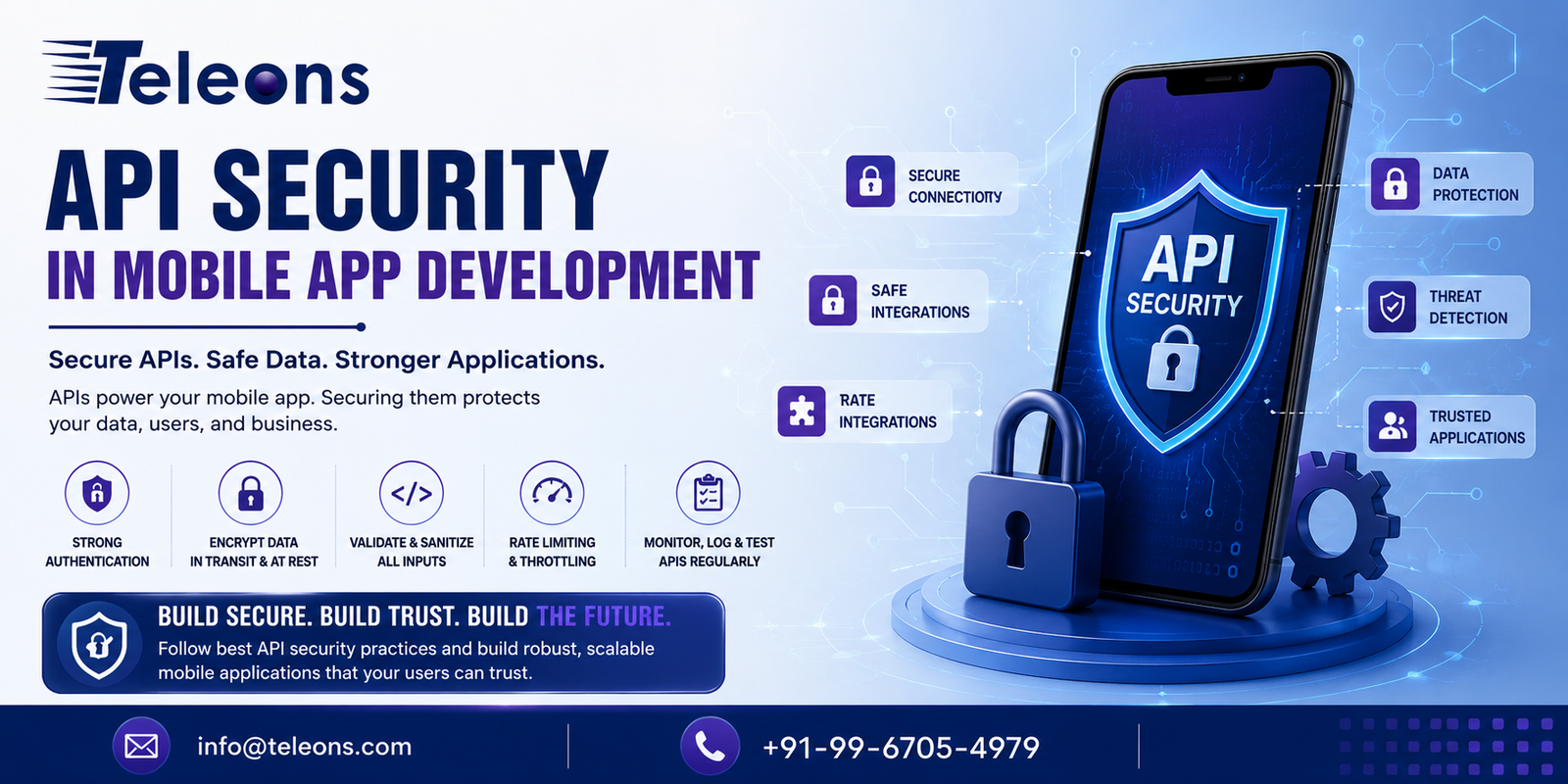
Introduction
Mobile applications have become an integral part of modern businesses, enabling users to shop, bank, communicate, book services, and manage their daily activities with ease. Behind every successful mobile app is a network of Application Programming Interfaces (APIs) that enable communication between the app, servers, databases, and third-party services. APIs power essential features such as user authentication, payment processing, push notifications, maps, cloud storage, and data synchronization.
While APIs make mobile apps more functional and efficient, they also introduce security risks if not properly protected. Cybercriminals often target APIs to gain unauthorized access, steal sensitive user data, manipulate transactions, or disrupt services. As mobile applications continue to handle increasing amounts of personal and financial information, securing APIs has become a critical aspect of mobile app development.
In this blog, we’ll explore the importance of API security, common vulnerabilities, and best practices to help businesses build secure Android and iOS applications.
What Is API Security?
API security refers to the practices, technologies, and policies used to protect APIs from unauthorized access, misuse, and cyberattacks. It ensures that only authenticated users and trusted systems can access data and services exposed through an API.
A secure API protects sensitive information, maintains application integrity, and helps businesses comply with industry regulations and privacy standards.
Why API Security Matters in Mobile App Development
Mobile apps rely heavily on APIs to exchange data between devices and servers. Without proper security, attackers can intercept communications, exploit vulnerabilities, or gain access to confidential information.
Strong API security helps businesses:
Protect customer data
Prevent unauthorized access
Reduce the risk of cyberattacks
Secure financial transactions
Maintain customer trust
Ensure regulatory compliance
Improve application reliability
Investing in API security safeguards both your business and your users.
Common API Security Threats
Broken Authentication
Weak authentication mechanisms can allow attackers to impersonate legitimate users and gain unauthorized access to accounts or sensitive information.
Prevention:
Implement OAuth 2.0 or OpenID Connect.
Use multi-factor authentication (MFA).
Enforce strong password policies.
Insecure Data Transmission
If API requests and responses are not encrypted, attackers may intercept sensitive information through man-in-the-middle (MITM) attacks.
Prevention:
Enforce HTTPS using TLS.
Encrypt sensitive data in transit.
Reject insecure HTTP connections.
Authorization Failures
Even authenticated users should only access data and functions they are permitted to use. Poor authorization controls can expose confidential information.
Prevention:
Implement role-based access control (RBAC).
Validate permissions on every request.
Follow the principle of least privilege.
API Key Exposure
Hardcoding API keys into mobile applications makes them vulnerable to extraction through reverse engineering.
Prevention:
Store secrets securely on the server.
Rotate API keys regularly.
Restrict API key permissions.
Injection Attacks
Improper validation of API inputs can lead to SQL injection, command injection, or other attacks that compromise databases and systems.
Prevention:
Validate and sanitize all user inputs.
Use parameterized database queries.
Employ secure coding practices.
Rate Limiting Issues
Without request limits, APIs may become targets for brute-force attacks or denial-of-service (DoS) attempts.
Prevention:
Implement rate limiting.
Monitor unusual traffic patterns.
Block suspicious IP addresses.
Best Practices for API Security
Use Strong Authentication
Authenticate users with secure protocols such as OAuth 2.0, JWT (JSON Web Tokens), or OpenID Connect. Avoid relying solely on usernames and passwords.
Encrypt All Data
Use HTTPS with TLS encryption for every API request and response. Encrypt sensitive information both during transmission and while stored on servers.
Validate Every Request
Never trust incoming data. Validate request parameters, headers, and payloads to prevent malicious input from reaching backend systems.
Implement Secure Authorization
Use role-based or attribute-based access controls to ensure users only access authorized resources.
Protect API Keys and Tokens
Never embed API secrets directly into the application code. Store them securely and issue short-lived access tokens wherever possible.
Monitor API Activity
Use logging and monitoring tools to detect suspicious behavior, failed login attempts, unusual request patterns, and potential attacks.
Keep APIs Updated
Regularly update frameworks, libraries, and dependencies to address known security vulnerabilities and apply security patches promptly.
Conduct Security Testing
Perform penetration testing, vulnerability assessments, and API security audits before releasing updates. Continuous testing helps identify weaknesses early.
Benefits of Secure APIs
A secure API infrastructure provides several advantages:
Stronger customer trust
Better protection of sensitive data
Reduced cybersecurity risks
Improved application reliability
Compliance with data protection regulations
Lower chances of financial loss due to breaches
Enhanced brand reputation
Security should be viewed as a long-term investment rather than an optional feature.
Common API Security Mistakes
Avoid these common errors:
Hardcoding API keys into mobile apps
Ignoring HTTPS encryption
Weak authentication methods
Poor authorization controls
Lack of input validation
Exposing excessive data through APIs
Not monitoring API traffic
Failing to update dependencies
Insufficient testing before deployment
How Teleons Builds Secure Mobile Applications
At Teleons, security is integrated into every stage of the mobile app development lifecycle. Our team follows industry-standard security practices to build Android and iOS applications with secure API architectures, encrypted communications, robust authentication systems, and comprehensive authorization controls.
We implement secure coding standards, regular vulnerability assessments, API monitoring, and performance optimization to ensure your application remains protected against evolving cyber threats. Whether you’re developing an eCommerce platform, healthcare app, fintech solution, logistics application, or enterprise software, Teleons delivers scalable and secure mobile applications designed to protect both your business and your users.
Conclusion
APIs are the backbone of modern mobile applications, but they also represent one of the most common attack surfaces. Implementing strong authentication, encryption, access control, input validation, monitoring, and regular security testing significantly reduces the risk of data breaches and cyberattacks.
Businesses that prioritize API security not only protect sensitive information but also build greater customer confidence and ensure long-term application success. Partnering with experienced mobile app developers like Teleons helps ensure your app is secure, reliable, and ready to scale in today’s digital environment.
Build Secure Mobile Applications with Teleons
Your mobile app is only as secure as the APIs that power it. Protect your users, safeguard sensitive data, and strengthen your business with robust API security built into every stage of development.
Teleons specializes in secure Android and iOS app development, API integration, cloud solutions, and enterprise-grade security practices. From authentication and encryption to API monitoring and vulnerability testing, our experts build applications that are designed for performance, scalability, and security.
Contact Teleons today to develop a secure, future-ready mobile application that delivers exceptional user experiences while protecting your business from evolving cyber threats.
Company Name: Teleons
Website: https://teleons.com/
Phone: +91-99-6705-4979
Email: info@teleons.com
Frequently Asked Questions (FAQs)
1. What is API security in mobile app development?
API security involves protecting the communication between a mobile app and its backend services from unauthorized access, attacks, and data breaches.
2. Why is API security important?
It safeguards sensitive user data, prevents unauthorized access, protects business operations, and helps maintain customer trust.
3. What are the most common API security threats?
Common threats include broken authentication, insecure data transmission, authorization failures, API key exposure, injection attacks, and denial-of-service (DoS) attacks.
4. How does HTTPS improve API security?
HTTPS encrypts data exchanged between the app and server, reducing the risk of interception during transmission.
5. Should API keys be stored inside a mobile app?
No. API keys and secrets should be stored securely on the server, not hardcoded into the app, to prevent exposure through reverse engineering.
6. What authentication methods are recommended for APIs?
OAuth 2.0, JWT (JSON Web Tokens), OpenID Connect, and Multi-Factor Authentication (MFA) are widely recommended for secure API authentication.
7. How often should APIs undergo security testing?
APIs should be tested regularly, especially before major releases, after significant updates, and as part of continuous security monitoring.
8. How does Teleons ensure API security in mobile apps?
Teleons follows secure development practices, including encrypted communication, secure authentication, authorization controls, vulnerability testing, API monitoring, and regular security updates to build safe and reliable mobile applications.


Related Posts

App Store Optimization: How to Get More App Downloads
Building a mobile app is only the first step. The next challenge is getting people to discover, download and use it. With thousands of apps…
Read More
How Mobile Apps Help Businesses Improve Customer Engagement
Introduction Customer engagement has become a critical factor in building a successful business. Customers today expect brands to be accessible, responsive, personalized, and convenient across…
Read More