




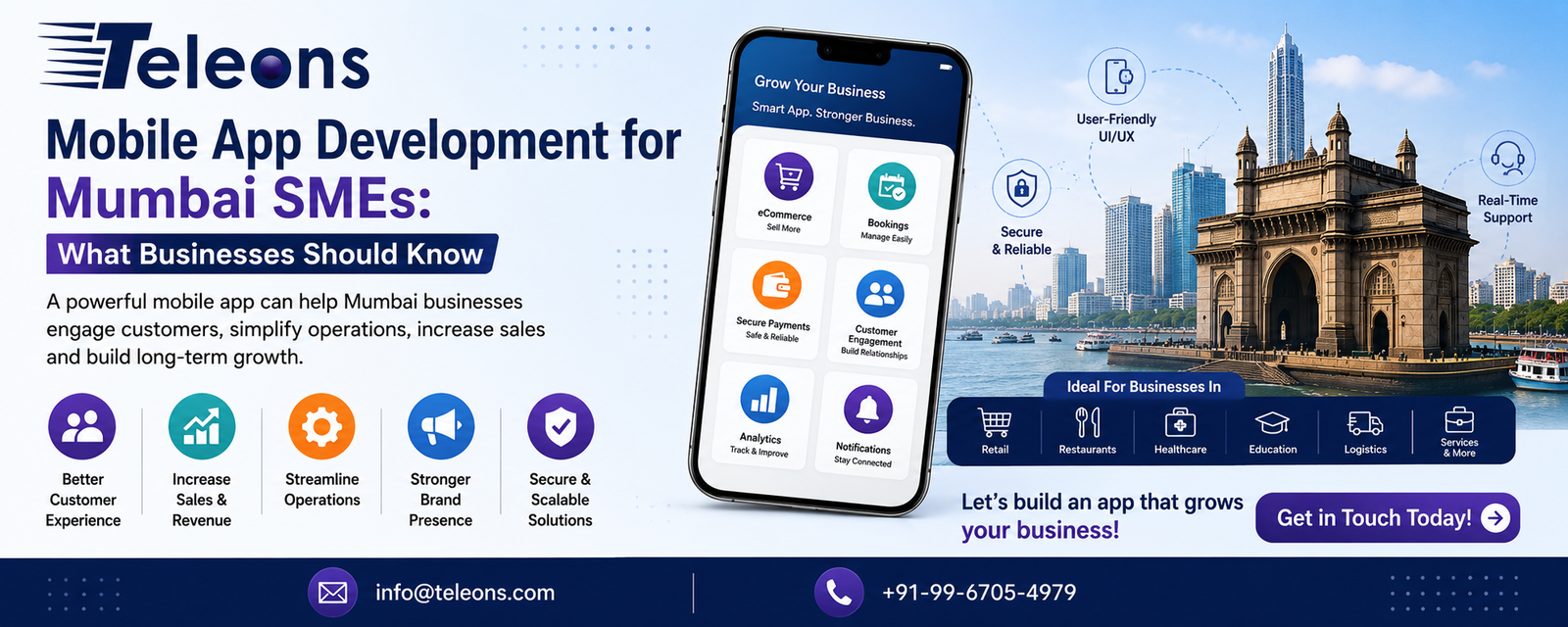
Mumbai is home to businesses across retail, restaurants, healthcare, education, finance, logistics, real estate, professional services and eCommerce. As customers increasingly use smartphones to discover businesses, place orders, make payments and communicate with brands, a mobile app can become a valuable digital channel for small and medium-sized enterprises (SMEs). For Mumbai SMEs, however, app development should not begin with technology alone. Businesses should first identify a genuine customer problem, define the app’s purpose, choose the right features and plan for security, scalability and ongoing maintenance.
Why Mumbai SMEs Should Consider a Mobile App
A website is essential for establishing an online presence, but an app can provide a more direct and personalized way to interact with existing customers. Depending on the business model, an app can support online ordering, bookings, loyalty programs, customer accounts, payments, notifications, service requests and real-time updates.
For example, a Mumbai restaurant could use an app for direct ordering and loyalty rewards, while a fitness centre could use one for class bookings and memberships. A retail business could provide personalized offers, and a service company could allow customers to schedule appointments and track requests.
The right use case depends on the business and its customers. An app should solve a specific problem rather than simply duplicate a company’s website.
What Should an SME App Achieve?
Before approaching a mobile app development company, Mumbai SMEs should establish clear objectives. These could include:
Increasing repeat purchases
Improving customer retention
Simplifying bookings or orders
Offering personalized experiences
Providing faster customer support
Creating a loyalty program
Automating routine processes
Improving communication with customers
Generating additional sales channels
Having measurable objectives makes it easier to determine whether the investment is delivering business value.
Essential Features for a Mumbai SME Mobile App
The required features will vary by industry, but many business applications can benefit from:
User Registration and Profiles
Allow customers to create accounts, manage personal information, view orders or bookings and access relevant services.
Push Notifications
Businesses can use notifications to communicate order updates, appointment reminders, promotions, new products and other relevant information. Notifications should be useful rather than excessive.
Online Payments
For businesses accepting digital payments, secure payment integration can make transactions more convenient. The payment system should be selected according to the business model, target customers and required payment methods.
Search and Navigation
For apps with multiple products, services or locations, effective search and navigation can help customers find what they need quickly.
Booking or Ordering
Restaurants, salons, clinics, fitness centres, educational businesses and service providers can use booking or ordering features to reduce manual processes.
Customer Support
In-app chat, support forms, FAQs or contact options can give customers an easier way to get assistance.
Analytics
Analytics can help businesses understand app usage, popular features, customer journeys and conversions. These insights can support future product decisions.
Choosing the Right App Development Approach
Mumbai SMEs have several options when developing an application. Native development creates separate applications for platforms such as Android and iOS, while cross-platform frameworks can allow businesses to develop applications for multiple platforms from a shared codebase.
The right approach depends on factors such as:
Target audience
Required features
Performance requirements
Development budget
Timeline
Future scalability
Maintenance requirements
A professional development team can help evaluate these factors before development begins.
How Much Does Mobile App Development Cost for an SME?
There is no single price for developing a business app. The total cost depends on the complexity of the product rather than simply the number of screens.
Important cost factors include:
UI/UX design
Number of platforms
Number and complexity of features
Backend development
API integrations
Payment integration
Third-party services
Security requirements
Admin dashboard
Testing
Deployment
Maintenance and updates
A basic business application may require considerably less investment than a marketplace, logistics platform or feature-rich eCommerce application.
Instead of choosing a developer solely on the lowest quotation, SMEs should evaluate technical expertise, development methodology, communication, security practices, post-launch support and scalability.
Start With an MVP
For many SMEs, developing a Minimum Viable Product (MVP) can be a practical approach. Rather than building every possible feature from day one, the business launches a version containing the essential functionality.
An MVP can help businesses:
Test the core idea.
Collect feedback from real users.
Identify the most valuable features.
Reduce unnecessary initial development.
Improve the product based on actual usage.
Once the application demonstrates demand, additional features can be introduced in later development phases.
Mobile App Security Should Be a Priority
An app may handle customer accounts, personal information, transactions and business data. Security therefore needs to be considered throughout development.
Businesses should discuss areas such as:
Secure authentication
Data encryption
Secure API communication
Access controls
Payment security
Regular security updates
Secure data storage
Vulnerability testing
Security should not be treated as an optional feature added after development.
App Maintenance Doesn’t End at Launch
Launching an app is only the beginning. Operating systems, devices, third-party APIs and security requirements change over time. Apps may also require performance improvements, bug fixes and new functionality.
A long-term maintenance plan can include:
Bug fixing
Security updates
OS compatibility updates
Performance optimization
Analytics monitoring
Feature enhancements
Server and API maintenance
Businesses should therefore consider ongoing maintenance costs when planning their app investment.
How a Mobile App Can Support Different Mumbai SMEs
Retail Businesses
Apps can support product discovery, offers, loyalty programs, orders and customer communication.
Restaurants
Restaurants can provide direct ordering, table reservations, loyalty rewards and delivery updates.
Healthcare Businesses
Apps can facilitate appointment bookings, reminders, digital communication and other patient-facing services, subject to applicable privacy and regulatory requirements.
Education Businesses
Educational businesses can provide course information, schedules, learning resources, notifications and student communication.
Logistics Businesses
Logistics companies can use apps for order management, delivery tracking, driver communication and customer updates.
Real Estate Businesses
Real estate businesses can provide property listings, enquiry forms, appointment scheduling and lead management.
How to Choose a Mobile App Development Partner in Mumbai
Before selecting a development company, SMEs should ask:
Have they developed similar applications?
Can they provide relevant case studies?
How do they handle UI/UX design?
Which technologies do they recommend and why?
How will the backend and APIs be developed?
What testing process do they follow?
How do they approach app security?
What support is available after launch?
How will the application scale as users increase?
Who owns the source code and intellectual property?
A good development partner should understand the business objective, not simply build the features listed in a specification.
Conclusion
For Mumbai SMEs, mobile app development can create a direct digital channel for customer engagement, sales, bookings, payments and service delivery. However, successful app development requires more than simply creating an attractive interface.
Businesses should start with a clear problem, identify their target users, prioritize essential features, select an appropriate development approach and plan for security, scalability and maintenance. Starting with an MVP can also help SMEs validate their idea before making a larger investment.
With the right strategy and development partner, a mobile app can become a practical extension of an SME’s business—not just another digital platform.
Turn Your Business Idea Into a Mobile App
Ready to take your Mumbai SME digital? Teleons can help businesses plan, design and develop mobile applications tailored to their business goals and customer needs.
From UI/UX and mobile app development to backend integration and ongoing support, build an app designed for real-world business growth.
Have a mobile app idea? Talk to Teleons today and start planning your digital product.
Website: Teleons
Phone: +91-99-6705-4979
Email: info@teleons.com
Frequently Asked Questions
1. Is a mobile app worth it for a small business in Mumbai?
It can be, particularly when an app solves a recurring customer problem such as ordering, booking, payments, loyalty or service management. The business case should be evaluated before development.
2. How much does it cost to develop a mobile app in Mumbai?
The cost varies according to features, platforms, integrations, UI/UX requirements, backend complexity, security and maintenance. A detailed requirement analysis is needed for an accurate estimate.
3. Should an SME build an Android app, iOS app or both?
The decision should be based on the target audience, market requirements, budget and business objectives. Cross-platform development can also be considered when reaching users on multiple platforms is important.
4. What features should an SME include in its first app?
Start with features directly connected to the primary business objective. Depending on the industry, this could include registration, profiles, ordering or booking, payments, notifications, customer support and analytics.
5. What is an MVP in mobile app development?
An MVP, or Minimum Viable Product, is an initial version containing the core features needed to test an app idea with real users and gather feedback.
6. How long does it take to develop a business mobile app?
Development time depends on the app’s complexity, number of platforms, integrations, design requirements and testing. A simple application may take significantly less time than a complex marketplace or enterprise platform.
7. Is app maintenance necessary after launch?
Yes. Apps require ongoing updates for operating-system compatibility, security, bug fixes, performance and new business requirements.
8. Can a mobile app integrate with existing business software?
Yes. APIs can allow mobile applications to communicate with websites, CRMs, ERP systems, payment platforms and other business software when appropriate integrations are available.
9. How can SMEs make their mobile app successful?
Focus on solving a genuine customer problem, provide a simple user experience, ensure good performance, promote the app effectively and continuously improve it using user feedback and analytics.
10. Why should Mumbai SMEs work with an experienced app development company?
An experienced development partner can help with technology selection, UI/UX, development, testing, integrations, security, deployment and ongoing maintenance, reducing the risk of avoidable technical problems.


Related Posts
Automate Repetitive Tasks With Custom Software
Introduction Every business has routine tasks that need to be completed daily, from managing customer enquiries and sending emails to updating records, scheduling appointments, and…
Read More
App Store Optimization: How to Get More App Downloads
Building a mobile app is only the first step. The next challenge is getting people to discover, download and use it. With thousands of apps…
Read More