




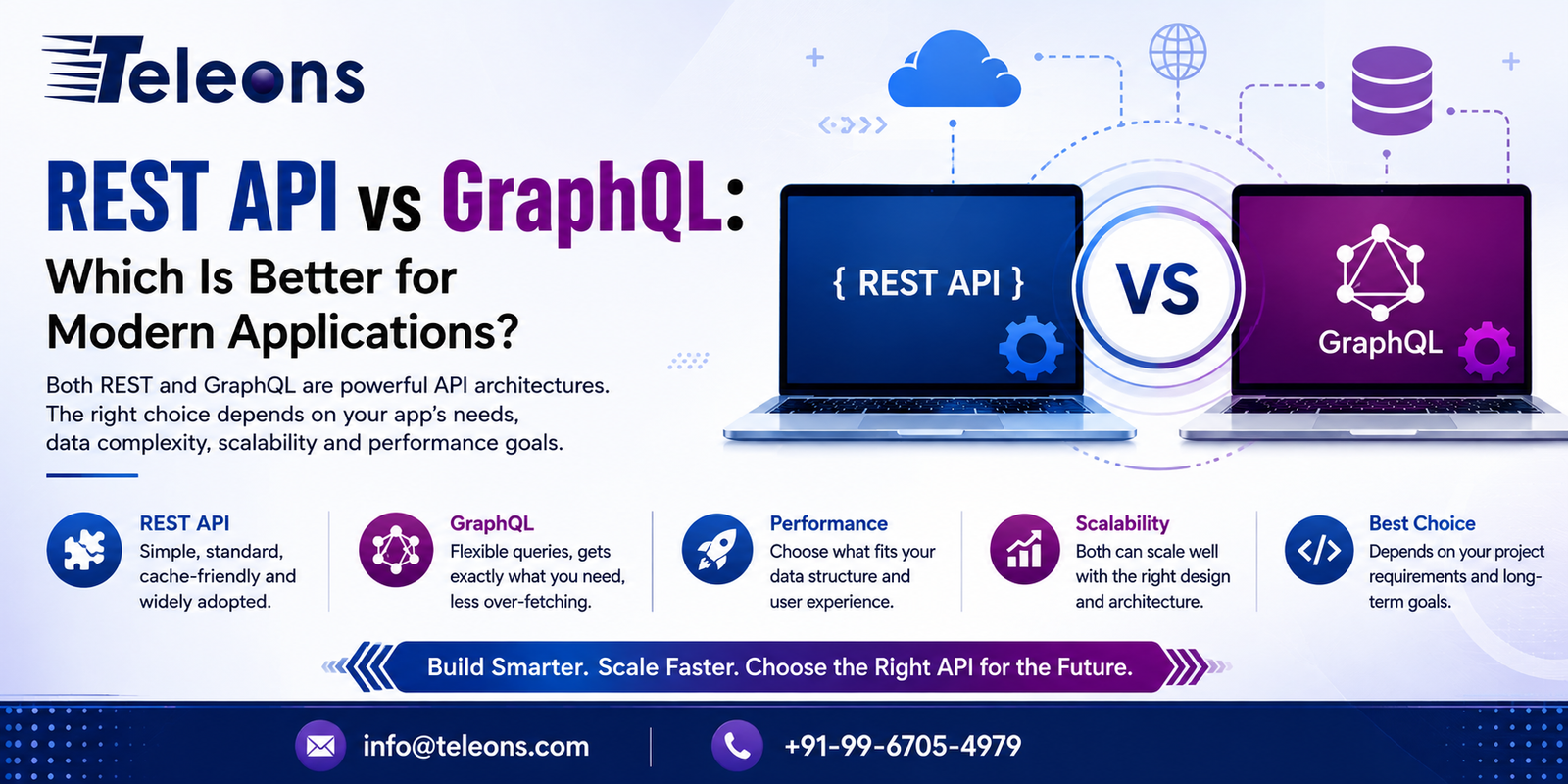
Modern applications rely heavily on APIs to connect mobile apps, websites, databases, payment systems, third-party platforms, and backend services. Two popular approaches for building APIs are REST and GraphQL.
Both can power scalable applications, but they work differently. Choosing between them depends on your application’s requirements, data structure, development resources, performance needs, and future scalability.
What Is a REST API?
REST (Representational State Transfer) is an architectural approach widely used to build web APIs. REST APIs typically use HTTP methods such as GET, POST, PUT, PATCH, and DELETE to perform operations on resources.
For example, an e-commerce application might have separate endpoints for products, customers, orders, and payments.
Advantages of REST
Simple and widely understood
Works well with standard HTTP methods
Easy to integrate with different platforms
Supports caching effectively
Mature tools and development ecosystem
Suitable for many web and mobile applications
Limitations of REST
REST can sometimes return more data than the application actually needs, or require multiple API requests to retrieve related information. As applications become more complex, managing numerous endpoints can also become challenging.
What Is GraphQL?
GraphQL is an API query language and runtime that allows clients to request exactly the data they need.
Instead of relying on multiple resource-based endpoints, GraphQL commonly uses a single endpoint where the client specifies the required fields.
For example, a mobile application could request a customer’s name, profile image, and recent orders in one query rather than making several separate requests.
Advantages of GraphQL
Clients can request specific data
Can reduce unnecessary data transfer
Useful for complex and interconnected data
Provides a strongly typed schema
Can simplify data retrieval for frontend applications
Useful when multiple platforms need different data
Limitations of GraphQL
GraphQL can introduce additional complexity in areas such as caching, query optimization, authorization, monitoring, and server-side performance management. Teams may also need to learn GraphQL-specific concepts and tooling.
REST API vs GraphQL: Key Differences
Feature REST GraphQL
API Structure Multiple resource-based endpoints Typically a unified endpoint
Data Retrieval Server determines response structure Client specifies required fields
Over-fetching Can occur Can be reduced
Under-fetching May require multiple requests Can often retrieve related data in one query
Caching Straightforward HTTP caching Requires more specialized strategies
Learning Curve Generally easier Requires GraphQL concepts
Flexibility Good Very high
Complex Data Can require multiple endpoints Well suited to connected data
Best Fit Conventional web and mobile APIs Data-rich and highly interactive applications
When Should You Choose REST?
REST can be an excellent choice when your application has relatively straightforward resources and predictable API requirements.
Consider REST when:
Your team already has strong REST experience
Your API has clearly defined resources
Simple integration is important
HTTP caching is a major requirement
You need a mature and familiar architecture
Your application does not require highly customized data queries
For many business applications, REST provides a practical balance of simplicity, reliability, and scalability.
When Should You Choose GraphQL?
GraphQL can be particularly useful when applications work with complex relationships or when different clients require different data.
Consider GraphQL when:
Mobile and web clients require different data
Your application has complex data relationships
You want clients to control the fields they receive
Reducing unnecessary data transfer is important
You are building highly interactive applications
Multiple frontend experiences consume the same backend
REST vs GraphQL for Mobile Apps
For mobile applications, API efficiency can be particularly important because users may operate under limited bandwidth or variable network conditions.
GraphQL can allow a mobile client to request only the information required for a particular screen. REST, however, remains a strong option when the application’s API requirements are straightforward and predictable.
The right choice depends on the application’s architecture rather than simply choosing the newer technology.
REST vs GraphQL: Which Is Better?
There is no universal winner.
REST is often the better choice for applications that prioritize simplicity, predictable resources, established standards, and straightforward caching.
GraphQL can be a better fit for applications requiring flexible queries, complex relationships, and different data requirements across clients.
The most important consideration is not which technology is more popular, but which API architecture aligns with your application’s business and technical requirements.
How Teleons Can Help
Choosing the right API architecture can have a significant impact on an application’s scalability, performance, maintainability, and user experience.
Teleons can help businesses plan and develop modern web and mobile applications with appropriate backend architecture, API integration, and scalable technology solutions.
Whether your project requires REST APIs, GraphQL, third-party integrations, or a complete mobile application, selecting the right architecture at the beginning can help create a stronger technical foundation.
Building a modern web or mobile application?
Don’t let API architecture become an afterthought. Choose an API strategy designed around your application’s users, data, integrations, and future growth.
👉 Talk to Teleons to discuss your application development requirements and build a scalable digital solution with the right technology architecture.
Company Name: Teleons
Website: https://teleons.com/
Phone: +91-99-6705-4979
Email: info@teleons.com
Frequently Asked Questions
1. Is GraphQL better than REST?
Not necessarily. Both have advantages. REST is often simpler and more established, while GraphQL provides greater flexibility in retrieving complex data.
2. Is GraphQL faster than REST?
GraphQL is not automatically faster. Its performance depends on how queries and the backend are designed. It can reduce unnecessary data transfer in some use cases.
3. Which is easier to develop, REST or GraphQL?
REST is generally easier for teams that are already familiar with HTTP and conventional API development. GraphQL introduces additional concepts such as schemas, queries, mutations, and resolvers.
4. Which is better for mobile applications?
Both can work well. GraphQL can be useful when mobile clients need flexible or highly specific data, while REST is often suitable for simpler applications with predictable API requirements.
5. Can REST and GraphQL be used together?
Yes. Some applications use both approaches, depending on the requirements of different services or parts of the system.
6. Which API is better for scalability?
Both REST and GraphQL can support scalable applications. Scalability depends heavily on backend architecture, database design, caching, infrastructure, and implementation quality.
7. How do I choose between REST and GraphQL?
Evaluate your application’s data complexity, client requirements, caching needs, development expertise, performance goals, and long-term maintenance requirements before making a decision.


Related Posts
App Store Optimization: How to Get More App Downloads
Building a mobile app is only the first step. The next challenge is getting people to discover, download and use it. With thousands of apps…
Read More
How Mobile Apps Help Businesses Improve Customer Engagement
Introduction Customer engagement has become a critical factor in building a successful business. Customers today expect brands to be accessible, responsive, personalized, and convenient across…
Read More