




Introduction
Mobile applications have become an essential part of modern business strategies. Whether you’re a startup, SME, or large enterprise, a mobile app can help improve customer engagement, streamline operations, and increase revenue. However, one of the biggest decisions businesses face before starting an app development project is choosing between Native Apps and Hybrid Apps.
Both approaches have their own advantages, limitations, and ideal use cases. The right choice depends on your business goals, budget, timeline, and performance requirements. In this guide, we’ll compare native and hybrid apps in detail to help you make an informed decision. At Teleons, we specialize in developing high-performance native and hybrid mobile applications tailored to meet unique business needs.
What is a Native App?
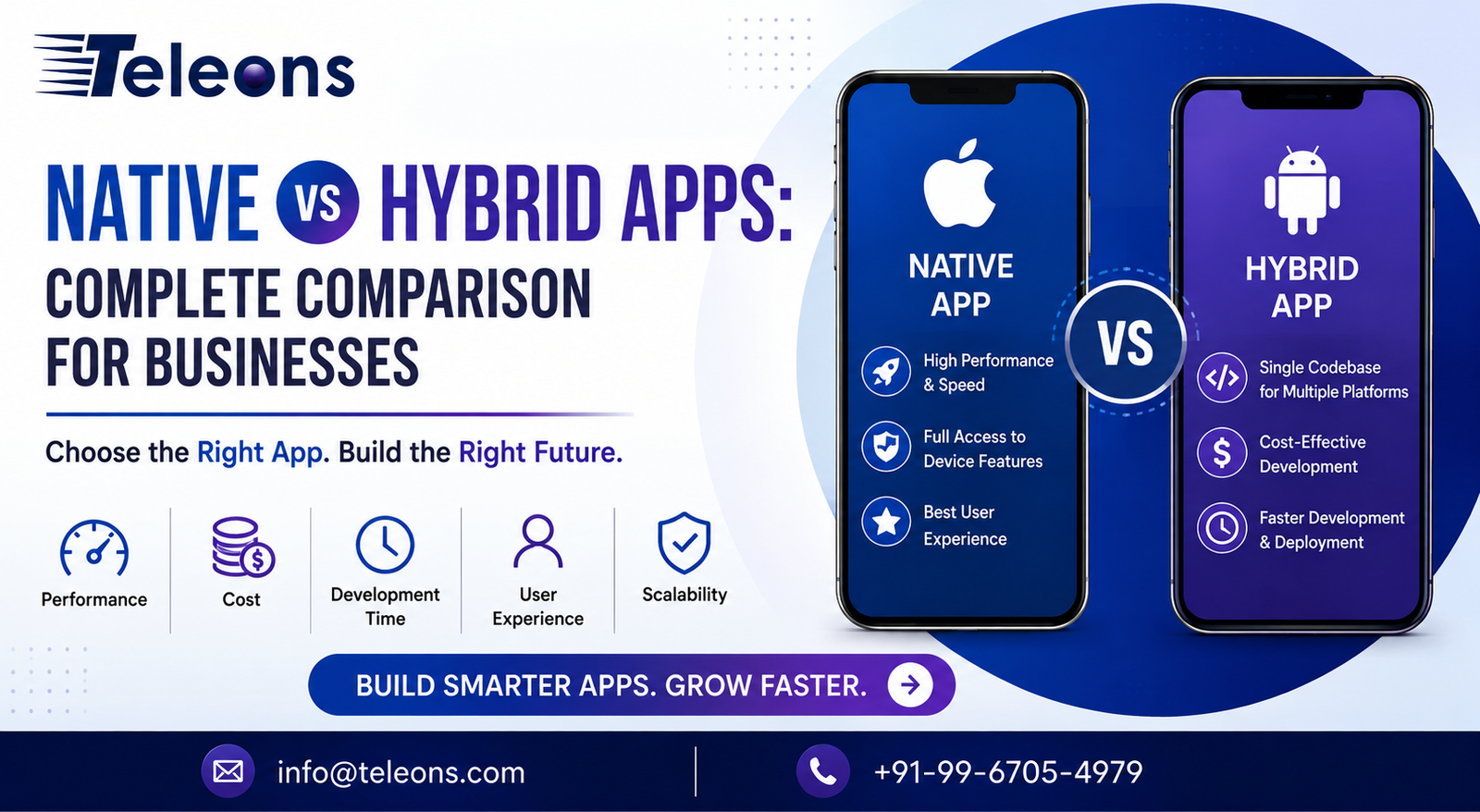
A Native App is developed specifically for a single operating system, such as Android or iOS, using platform-specific programming languages and tools. Android apps are commonly built using Kotlin or Java, while iOS apps are developed using Swift or Objective-C. Since native apps are designed exclusively for one platform, they can fully utilize device features like the camera, GPS, Bluetooth, biometrics, and push notifications.
Native apps are known for their superior speed, responsiveness, and user experience, making them an excellent choice for businesses that require high performance and seamless functionality.
What is a Hybrid App?
A Hybrid App is built using web technologies such as HTML, CSS, and JavaScript and is wrapped within a native container. This allows a single codebase to run on both Android and iOS devices. Popular frameworks for hybrid app development include Flutter, React Native, Ionic, and Apache Cordova.
Hybrid apps are ideal for businesses looking to launch quickly while keeping development costs lower. They offer cross-platform compatibility and reduce the need to maintain separate codebases for different operating systems.
Native Apps vs Hybrid Apps: Key Differences
1. Performance
Native apps provide excellent performance because they are built specifically for a single operating system. They deliver smooth animations, faster loading times, and superior responsiveness. Hybrid apps have improved significantly in recent years, especially with frameworks like Flutter and React Native, but they may still experience slight performance limitations in graphics-intensive or highly complex applications.
2. Development Cost
Developing native apps requires separate applications for Android and iOS, increasing both development time and cost. Hybrid apps use a single codebase for multiple platforms, making them a more cost-effective option for startups and businesses with limited budgets.
3. Development Time
Hybrid apps generally have shorter development cycles because developers write the code once and deploy it across multiple platforms. Native apps require separate development efforts for Android and iOS, resulting in longer project timelines.
4. User Experience
Native applications provide a platform-specific look and feel that aligns with Android and iOS design guidelines. This creates a smoother and more intuitive user experience. Hybrid apps strive to deliver consistent interfaces across platforms, but may not always achieve the same level of native responsiveness.
5. Device Features
Native apps have unrestricted access to device hardware and operating system features, making them ideal for applications that rely heavily on camera functions, GPS navigation, Bluetooth connectivity, augmented reality, or biometric authentication. Hybrid frameworks support many of these features through plugins, although some advanced capabilities may require additional customization.
6. Maintenance
Maintaining native apps involves updating separate codebases for Android and iOS, which can increase long-term maintenance costs. Hybrid apps simplify maintenance since updates can often be applied to a single shared codebase, reducing time and effort.
Advantages of Native Apps
Native applications deliver outstanding speed, reliability, and user experience. They provide full access to device capabilities, offer stronger security, support offline functionality, and perform exceptionally well for gaming, fintech, healthcare, and enterprise applications where performance is critical. Businesses seeking premium-quality applications with long-term scalability often prefer native development.
Advantages of Hybrid Apps
Hybrid applications offer faster development, reduced costs, and easier maintenance through a shared codebase. They allow businesses to launch on both Android and iOS simultaneously while maintaining consistent functionality across platforms. Hybrid development is especially suitable for startups, MVPs, eCommerce apps, educational apps, booking platforms, and internal business applications where rapid deployment is important.
Which Option Should Your Business Choose?
The decision between native and hybrid app development depends on your business objectives. If your application requires maximum performance, complex animations, advanced device integration, or exceptional user experience, native development is the better investment. However, if your goal is to validate an idea quickly, reach multiple platforms with limited resources, or reduce development costs, a hybrid application is often the ideal solution.
Businesses should also consider future scalability, expected user traffic, maintenance requirements, and available budget before making a decision. Consulting with experienced developers can help determine the most suitable approach for your project.
Why Choose Teleons for Mobile App Development?
At Teleons, we help businesses transform ideas into feature-rich mobile applications that deliver measurable results. Our experienced team develops both native and hybrid apps using modern technologies such as Flutter, React Native, Kotlin, Swift, and other industry-leading frameworks. From business analysis and UI/UX design to development, testing, deployment, and ongoing support, we provide end-to-end mobile app development services tailored to your goals. Whether you’re building an MVP, enterprise application, or customer-facing mobile app, Teleons ensures scalable, secure, and high-performing solutions that drive business growth.
Conclusion
Both native and hybrid mobile apps offer valuable advantages, and neither approach is universally better than the other. The right choice depends on your project’s requirements, budget, timeline, and long-term objectives. Native apps excel in performance, security, and user experience, while hybrid apps provide faster development and cost-effective cross-platform compatibility. Understanding these differences helps businesses invest in the right technology from the beginning. By partnering with Teleons, you can confidently choose the best development approach and build a mobile application that supports your business growth for years to come.
Build the Right Mobile App with Teleons
Not sure whether a native or hybrid app is right for your business? Teleons is here to help. Our mobile app development experts analyze your business requirements and recommend the best technology stack to maximize performance, scalability, and return on investment. From strategy and UI/UX design to development, testing, deployment, and maintenance, we provide complete mobile app development solutions for startups, SMEs, and enterprises.
Contact Teleons today to build a powerful Android, iOS, or cross-platform mobile app that accelerates your business growth.
Company Name: Teleons
Website: https://teleons.com/
Phone: +91-99-6705-4979
Email: info@teleons.com
Frequently Asked Questions (FAQs)
1. What is the difference between native and hybrid apps?
Native apps are developed specifically for Android or iOS using platform-specific programming languages, while hybrid apps use a single codebase that works across multiple platforms.
2. Which is better for startups: native or hybrid apps?
Hybrid apps are generally better for startups because they reduce development costs, shorten time-to-market, and support both Android and iOS from a single codebase.
3. Are native apps faster than hybrid apps?
Yes. Native apps usually offer better speed, smoother performance, and greater responsiveness because they are built specifically for one operating system.
4. Which framework is best for hybrid app development?
Popular hybrid frameworks include Flutter and React Native, both of which enable developers to create high-quality cross-platform applications efficiently.
5. Can hybrid apps access device features like GPS and camera?
Yes. Modern hybrid frameworks support access to device features such as the camera, GPS, push notifications, and biometrics through plugins and native integrations.
6. Which type of app should I choose for my business?
If your app requires high performance and advanced functionality, choose native development. If you need faster development, lower costs, and cross-platform compatibility, a hybrid app is an excellent choice.


Related Posts
App Store Optimization: How to Get More App Downloads
Building a mobile app is only the first step. The next challenge is getting people to discover, download and use it. With thousands of apps…
Read More
How Mobile Apps Help Businesses Improve Customer Engagement
Introduction Customer engagement has become a critical factor in building a successful business. Customers today expect brands to be accessible, responsive, personalized, and convenient across…
Read More