




A mobile application’s interface might win over a user, but its backend architecture determines whether they stay.
The backend is the unseen engine driving data storage, user authentication, business logic, payment processing, push notifications, and API communications. Choosing the wrong stack leads to high latency, security vulnerabilities, and exorbitant technical debt when scaling.
Key Takeaway: The ideal backend doesn’t just fulfill today’s MVP feature list—it seamlessly supports your app’s user, data, and traffic growth two to three years down the line.
What Is a Mobile App Backend?
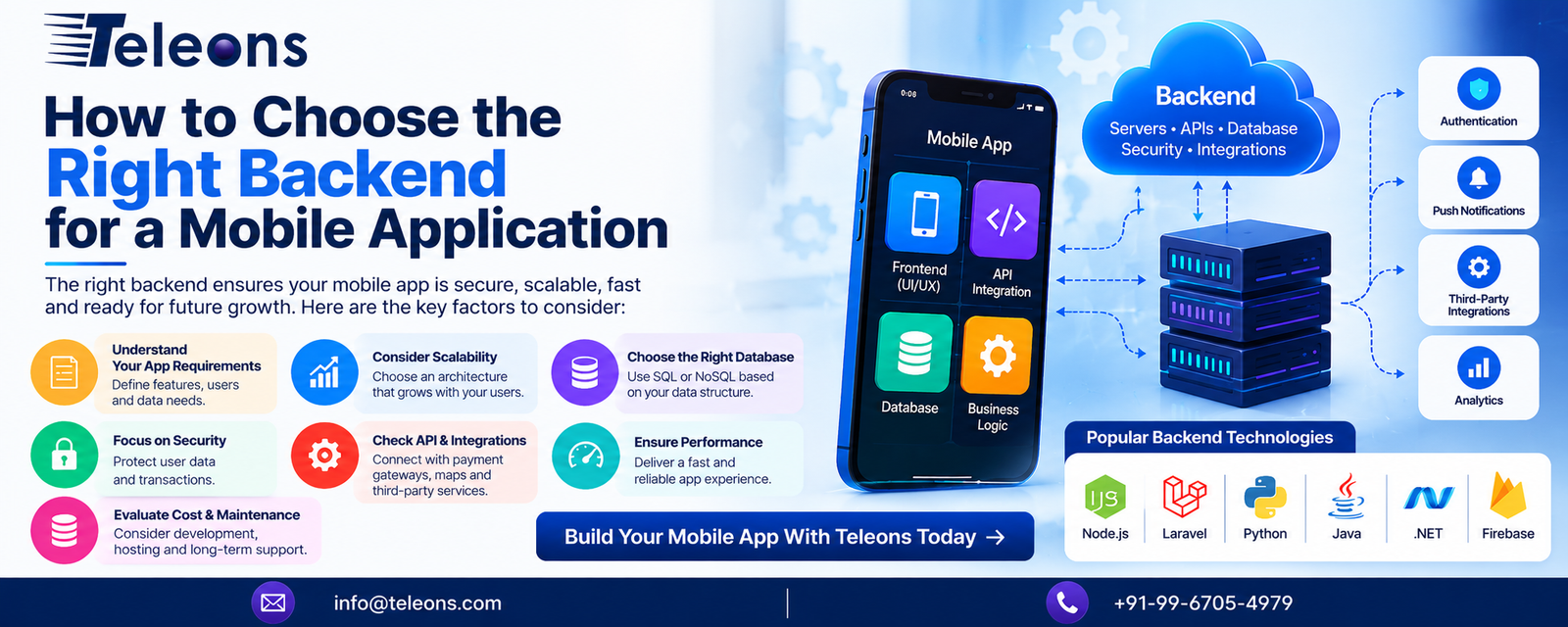
The backend is the server-side foundation of a mobile application. While users interact with the front-end UI on iOS or Android, the backend works behind the scenes to execute critical processes:
┌──> User Auth & Access Control
├──> Business Logic & API Endpoints
Backend Engine ┼──> Database & Cloud File Storage
├──> Third-Party Integrations (Payments, CRM, Maps)
└──> Real-Time Sockets & Push Notifications
For instance, when a customer purchases an item on an eCommerce app, the backend verifies inventory, processes payments via a secure gateway, records the order in a relational database, and triggers an automated confirmation email and push notification.
The Hidden Cost of Choosing the Wrong Stack
Selecting a technology stack based solely on current popularity or quick setup can result in critical bottlenecks:
Performance Degradation: High server latency during traffic spikes.
Complex Scaling: Poor database schemas that freeze under heavy concurrent read/write loads.
Security Vulnerabilities: Exposed API endpoints and unencrypted data pipelines.
Excessive Hosting Bills: Unoptimized serverless functions or inefficient database queries scaling cost instead of capacity.
10 Essential Factors for Evaluating Your Backend
1. Business Logic & Feature Requirements
Identify your core application demands before picking a language:
Do you require low-latency real-time data streaming (e.g., chat, ride-hailing)?
Will users upload high-resolution media or video content?
Do you require complex relational transactions (e.g., fintech, healthcare)?
2. SQL vs. NoSQL Database Selection
Criteria SQL (Relational) NoSQL (Non-Relational)
Examples PostgreSQL, MySQL, MSSQL MongoDB, Firestore, DynamoDB
Data Structure Highly structured, fixed schemas Flexible, document-oriented, key-value
Best Used For Financial transactions, inventory, complex relationships Social feeds, real-time messaging, unstructured logs
Scaling Vertical scaling (or complex sharding) Horizontal scaling out-of-the-box
3. API Architecture: REST vs. GraphQL
REST APIs: Standard, reliable, and cached easily. Ideal for straightforward resource interactions.
GraphQL: Allows mobile clients to request only the specific data fields needed. Reduces network payloads on poor cellular connections.
4. Real-Time Capabilities
If your app needs instant bidirectional communication (such as live tracking or active chat), choose stacks with built-in WebSocket support or event-driven models (e.g., Node.js, Socket.io).
5. Enterprise-Grade Security
Security must be built into the backend architecture from day one:
OAuth2 / JWT authentication pipelines
End-to-end data encryption (at rest and in transit)
Role-Based Access Control (RBAC) and strict input validation
Custom Backend vs. Backend-as-a-Service (BaaS)
Backend Options
│
┌───────────────────────┴───────────────────────┐
▼ ▼
Custom Backend Stack BaaS (e.g., Firebase)
┌───────────────────────────┐ ┌───────────────────────────┐
│ • Total architecture control│ │ • Rapid MVP deployment │
│ • Complex custom logic │ │ • Pre-built Auth & DBs │
│ • Zero vendor lock-in │ │ • High vendor lock-in │
└───────────────────────────┘ └───────────────────────────┘
Direct Comparison Matrix
Feature / Metric Custom Backend (Node, Laravel, Python) BaaS (Firebase, Supabase)
Development Speed Moderate to Long Rapid / Off-the-shelf
Infrastructure Control 100% Control Managed / Restricted
Customization Depth Unlimited Platform dependent
Scaling Costs Predictable server/cloud costs Pay-as-you-go (can spike at scale)
Vendor Independence High Low (Vendor Lock-in)
Popular Backend Technologies: Which One Fits Your App?
Node.js (JavaScript/TypeScript)
Best For: Real-time applications, microservices, high-concurrency API gateways, and chat/streaming platforms.
Strengths: Non-blocking I/O, massive npm ecosystem, unified JavaScript stack.
Laravel (PHP)
Best For: Rapid business app development, eCommerce platforms, robust admin panels, and RESTful APIs.
Strengths: Built-in ORM, authentication systems, queues, and clean MVC structure.
Python (Django / FastAPI)
Best For: Apps incorporating AI/ML models, data processing, computer vision, or fast API development.
Strengths: Clean syntax, strong scientific libraries, high security out of the box.
Java / Spring Boot
Best For: High-volume enterprise platforms, banking systems, and legacy enterprise integrations.
Strengths: Extreme stability, multi-threading performance, enterprise security standards.
Step-by-Step Decision Framework
[Define Core Features] ──> [Estimate Initial & Future Traffic] ──> [Select Database Type] ──> [Choose Custom vs. BaaS] ──> [Build & Load Test]
Audit Functional Requirements: List every API endpoint, payment step, and data integration needed.
Project 3-Year Scale: Plan database indexing, caching layers (Redis), and cloud hosting (AWS/GCP) for growth.
Establish Security Rules: Mandate compliance requirements (e.g., GDPR, HIPAA, PCI-DSS) early.
Evaluate Team Expertise: Choose a framework your development partner can build, test, and maintain efficiently.
Execute Load & Stress Tests: Simulate thousands of concurrent users before rolling out to production.
Build a Scalable Mobile App with Teleons
Building a high-performance app requires more than clean UI design—it demands a robust, secure, and scalable backend architecture.
At Teleons, based in Mumbai, we engineer custom mobile backends, high-throughput APIs, and scalable cloud architectures tailored to your business goals.
Partner with Teleons Today | Call Us: +91-99-6705-4979 | Email: info@teleons.com
Frequently Asked Questions
1. What is a mobile app backend?
A mobile app backend is the server-side infrastructure that manages user authentication, databases, business logic, push notifications, and API communications.
2. Is Node.js good for mobile app backends?
Yes. Node.js excels at managing concurrent API requests and real-time features like live messaging or tracking.
3. When should I choose Firebase over a custom backend?
Firebase is ideal for fast MVP builds, prototypes, or apps with straightforward database needs. Complex business logic and long-term cost optimization favor custom backends.
4. What database is best for my app: SQL or NoSQL?
Use SQL (PostgreSQL/MySQL) for structured data and complex transactions. Use NoSQL (MongoDB/Firestore) for flexible schemas and rapid real-time reads.
5. Can I migrate my backend after launching the app?
Yes, but migrating backends post-launch requires API versioning, data migration, and app updates. Planning a scalable stack from day one saves significant time and budget.


Related Posts
App Store Optimization: How to Get More App Downloads
Building a mobile app is only the first step. The next challenge is getting people to discover, download and use it. With thousands of apps…
Read More
How Mobile Apps Help Businesses Improve Customer Engagement
Introduction Customer engagement has become a critical factor in building a successful business. Customers today expect brands to be accessible, responsive, personalized, and convenient across…
Read More