




Introduction
In today’s digital-first business environment, efficiency and automation are essential for sustainable growth. Companies use multiple software applications such as CRM systems, accounting platforms, inventory management tools, e-commerce websites, payment gateways, and marketing platforms. Managing these systems manually can lead to inefficiencies, data duplication, and increased operational costs.
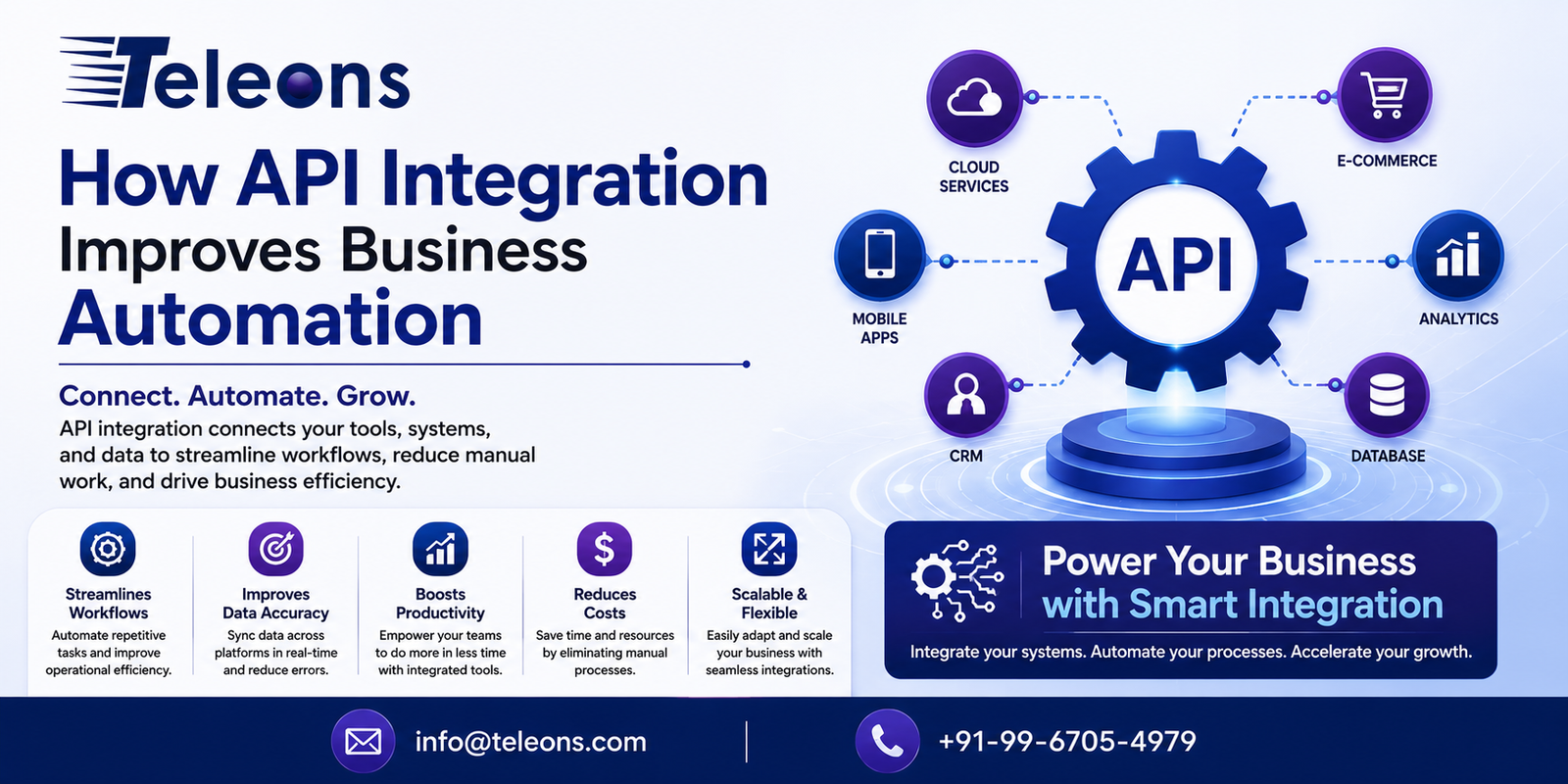
This is where API Integration becomes a game-changer. APIs (Application Programming Interfaces) enable different software applications to communicate and exchange data seamlessly, helping businesses automate repetitive tasks, improve productivity, and enhance customer experiences.
At Teleons, we help businesses leverage API integration to streamline operations, reduce manual work, and accelerate digital transformation.
What is API Integration?
API Integration is the process of connecting different software applications through APIs, allowing them to share data and perform actions automatically.
For example:
An e-commerce website can automatically update inventory levels in an ERP system.
A payment gateway can instantly notify an accounting system about completed transactions.
A CRM can automatically receive leads from website forms and marketing campaigns.
Instead of manually transferring information between systems, APIs automate the process in real time.
Why Business Automation Matters
Businesses today deal with large volumes of data and multiple workflows. Manual processes often result in:
Human errors
Delayed decision-making
Increased operational costs
Reduced employee productivity
Poor customer experiences
Business automation eliminates these challenges by enabling systems to work together seamlessly and efficiently.
Key Benefits of API Integration for Business Automation
Eliminates Manual Data Entry
Manual data entry consumes valuable time and increases the likelihood of errors.
With API integration:
Data transfers automatically between systems
Duplicate entries are eliminated
Accuracy improves significantly
Example:
When a customer places an order online, the order details can automatically sync with inventory, accounting, and shipping systems.
Improves Operational Efficiency
API integrations automate repetitive tasks that employees perform daily.
Examples include:
Lead management
Invoice generation
Inventory updates
Customer notifications
Order processing
This allows teams to focus on strategic activities rather than administrative work.
Enhances Customer Experience
Modern customers expect fast and seamless interactions.
API integration helps businesses:
Provide real-time order tracking
Offer instant payment confirmations
Deliver personalized recommendations
Automate customer support responses
These improvements lead to higher customer satisfaction and retention.
Enables Real-Time Data Synchronization
One of the biggest advantages of APIs is real-time data sharing.
Benefits include:
Up-to-date business information
Faster decision-making
Improved reporting accuracy
Better operational visibility
Managers can access current data instead of relying on outdated reports.
Reduces Human Errors
Manual processes often result in mistakes such as:
Incorrect customer information
Duplicate records
Inventory discrepancies
Billing errors
API automation ensures consistent and accurate data transfer across systems.
Supports Scalability
As businesses grow, manual workflows become increasingly difficult to manage.
API integration allows organizations to:
Handle larger transaction volumes
Connect new software platforms
Expand operations efficiently
Maintain productivity during growth
This scalability is crucial for long-term business success.
Streamlines Marketing Automation
Marketing teams use multiple platforms including:
CRM systems
Email marketing tools
Advertising platforms
Analytics software
API integration connects these systems to:
Automatically capture leads
Segment audiences
Track campaign performance
Personalize customer journeys
The result is more effective and data-driven marketing.
Improves Financial Management
Financial automation is one of the most valuable applications of API integration.
Businesses can automate:
Payment processing
Invoice creation
Expense tracking
Tax calculations
Financial reporting
This reduces accounting workloads and improves financial accuracy.
Common API Integration Use Cases
CRM Integration
Connect websites, marketing platforms, and customer databases for seamless lead management.
E-Commerce Integration
Synchronize products, orders, inventory, and customer information across platforms.
Payment Gateway Integration
Automate payment processing and transaction tracking.
ERP Integration
Streamline inventory, procurement, accounting, and supply chain operations.
Communication Integration
Connect messaging, email, and customer support systems for better engagement.
Cloud Application Integration
Enable seamless data exchange between cloud-based business applications.
Industries Benefiting from API Automation
API integration provides value across various industries:
Healthcare
Patient record synchronization
Appointment automation
Billing integration
Retail & E-Commerce
Inventory management
Order processing
Customer engagement
Finance
Payment automation
Fraud detection
Financial reporting
Education
Student management systems
Online learning platforms
Fee collection automation
Logistics
Shipment tracking
Route optimization
Warehouse management
Best Practices for Successful API Integration
Choose Reliable APIs
Work with trusted platforms that offer secure and well-documented APIs.
Prioritize Security
Implement authentication, encryption, and access controls to protect sensitive data.
Monitor Performance
Regularly track API performance to ensure reliability and efficiency.
Plan for Scalability
Select integrations that can accommodate future business growth.
Work with Experienced Developers
Professional API integration ensures smooth implementation and long-term success.
Why Choose Teleons for API Integration Services?
Teleons specializes in developing secure, scalable, and customized API integration solutions that help businesses automate operations and improve efficiency.
Our expertise includes:
CRM Integration
ERP Integration
Payment Gateway Integration
E-Commerce API Integration
Cloud Application Integration
Custom Software Development
Business Process Automation
We help organizations eliminate manual work, improve productivity, and accelerate digital transformation.
Conclusion
API integration has become a critical component of modern business automation. By connecting systems, automating workflows, and enabling real-time data sharing, APIs help businesses operate more efficiently while delivering superior customer experiences.
Whether you’re looking to automate sales, marketing, finance, customer service, or operations, API integration can significantly improve productivity and support long-term growth.
Partner with Teleons to unlock the full potential of API-driven business automation and take your digital transformation journey to the next level.
Automate Your Business with Smart API Integration
Looking to streamline operations, eliminate manual tasks, and connect your business applications seamlessly?
Teleons provides custom API integration solutions that improve efficiency, enhance productivity, and accelerate business growth.
Contact Teleons today for a free consultation and discover how API-driven automation can transform your business.
📞 : +91-99-6705-4979
🌐 : https://teleons.com/
Email: info@teleons.com
FAQs
1. What is API integration?
API integration is the process of connecting different software applications so they can communicate and exchange data automatically.
2. How does API integration improve business automation?
It eliminates manual tasks, automates workflows, improves data accuracy, and increases operational efficiency.
3. Which business systems can be integrated using APIs?
CRM, ERP, accounting software, payment gateways, e-commerce platforms, marketing tools, and customer support systems.
4. Is API integration secure?
Yes, when implemented properly using authentication, encryption, and security best practices.
5. Can API integration help small businesses?
Absolutely. Small businesses can automate repetitive tasks, reduce costs, and improve productivity through API integrations.
6. What industries benefit most from API integration?
Healthcare, finance, retail, e-commerce, logistics, education, and manufacturing all benefit significantly from API automation.
7. How long does API integration take?
The timeline depends on the complexity of the systems involved and the customization required.
8. Why should businesses invest in API integration?
API integration improves efficiency, enhances customer experiences, reduces errors, and supports business growth.


Related Posts

App Store Optimization: How to Get More App Downloads
Building a mobile app is only the first step. The next challenge is getting people to discover, download and use it. With thousands of apps…
Read More
How Mobile Apps Help Businesses Improve Customer Engagement
Introduction Customer engagement has become a critical factor in building a successful business. Customers today expect brands to be accessible, responsive, personalized, and convenient across…
Read More