




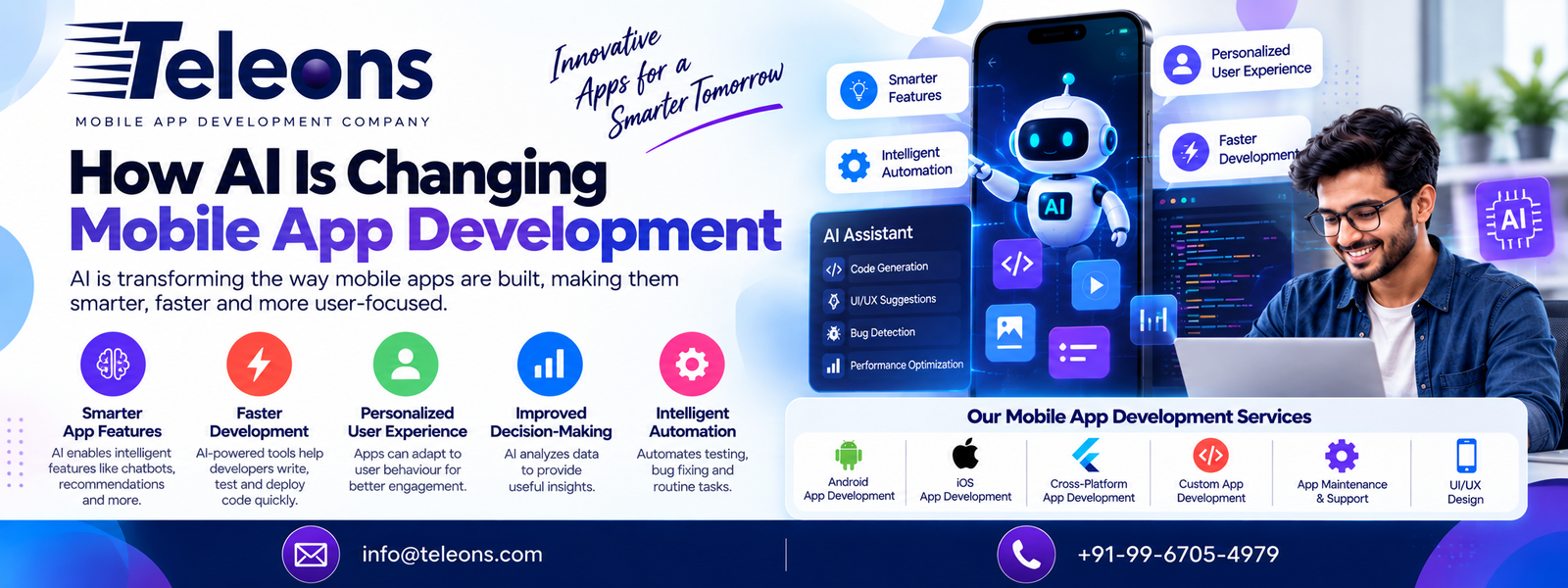
Artificial Intelligence (AI) has fundamentally changed how mobile applications are designed, architected, tested, deployed, and scaled. What once required hundreds of hours of manual engineering can now be accelerated using AI-driven workflows that help development teams write cleaner code, catch bugs preemptively, analyze user behavior in real time, and deliver personalized user experiences.
For businesses and product owners, mobile app development in 2026 is faster, more cost-efficient, data-driven, and hyper-focused on customer retention.
Whether you are looking to build a native Android or iOS application or leverage cross-platform frameworks like Flutter or React Native, understanding how AI is reshaping the app ecosystem will help you make smarter technology investments.
What Is AI in Mobile App Development?
AI in mobile app development refers to integrating machine learning (ML), natural language processing (NLP), computer vision, and generative models into both the development process itself (developer toolkits) and the end-user application (smart features).
┌──────────────────────────────────────────────┐
│ AI IN MOBILE APP ECOSYSTEM │
└──────────────────────┬───────────────────────┘
│
┌───────────────────────┴───────────────────────┐
▼ ▼
[Development Lifecycle] [In-App User Features]
─ Code Generation & Refactoring ─ Hyper-Personalization
─ Automated Bug Detection & QA ─ Predictive Search & Analytics
─ Security Vulnerability Scans ─ AI Chatbots & Voice Agents
14 Ways AI Is Revolutionizing Mobile App Development in 2026
1. Accelerating Engineering with AI-Assisted Coding
Modern engineering teams use AI coding assistants and agentic workflows to handle repetitive setup and boilerplate code.
Speeding Up Iterations: AI tools draft boilerplate code, suggest functions, convert logic between languages (e.g., Swift to Kotlin), and explain legacy code snippets.
Developer Focus: Engineers spend less time on manual syntax writing and more time on high-value system architecture, API design, security logic, and business features.
Note: AI-generated code still requires rigorous human code reviews to ensure reliability and maintainability.
2. Transforming Mobile App QA & Automated Testing
Testing across thousands of device fragmentation combinations (screen sizes, OS versions, GPU configs, network speeds) is one of the biggest bottlenecks in mobile delivery.
Predictive Test Generation: AI automatically generates test cases based on user journeys, flags visual regressions, and predicts potential edge-case crashes before release.
3. Delivering Hyper-Personalized User Experiences (UX)
Static mobile apps are being replaced by dynamic, context-aware interfaces.
Behavioral Adaptation: AI models analyze user navigation patterns, buying history, time of day, and location to tailor recommendations, feeds, layout hierarchies, and promotional offers in real time.
4. Deploying Intelligent, On-Device AI Chatbots
In-app conversational agents have evolved far beyond basic decision-tree bots.
Natural Context & Instant Action: Integrated LLM agents answer complex multi-turn inquiries, process orders, guide users through onboarding, and execute actions directly inside the app without human intervention.
5. Elevating Voice Interaction & Multimodal Capabilities
Voice UI has become a core accessibility and usability feature across consumer and enterprise apps.
Voice-Driven Workflows: Advanced speech-to-text and voice command recognition allow users to search catalog items, dictate notes, translate speech on the fly, or control apps entirely hands-free.
6. Revolutionizing Mobile UI/UX Design Processes
AI design tools allow product teams to rapidly prototype and iterate on user flows.
Data-Driven Design: Designers use AI to generate wireframes, run automated accessibility audits (contrast ratios, tap targets), and create personalized micro-interactions based on real user analytics.
7. Early Bug Detection & Code Quality Optimization
Catching structural flaws during development saves thousands of dollars compared to post-launch hotfixes.
Automated Static Analysis: AI constantly scans pull requests to identify memory leaks, race conditions, deprecated API usage, and unhandled exceptions before deployment.
8. Hardening Mobile App Security & Anti-Fraud Measures
Mobile apps are prime targets for data breaches, credential stuffing, and fraud.
Real-Time Threat Intelligence: AI algorithms monitor behavioral biometrics, flag suspicious login locations, detect device rooting/jailbreaking, and block anomalous payment patterns in milliseconds.
9. Leveraging Predictive Analytics for Higher Retention
Retaining mobile users is often harder than acquiring them.
Churn Prevention: Machine learning models predict when a user is likely to abandon an app, enabling automated re-engagement via tailored push notifications, discounts, or updated content recommendations.
10. Making Apps Universally Accessible
AI enables inclusive app experiences for users of all abilities.
Smart Accessibility: Features like automated real-time screen reader descriptions, dynamic text sizing, live closed captions, and voice-guided touch targets make digital products universally accessible.
11. Supercharging Cross-Platform App Frameworks
Cross-platform development using Flutter and React Native has reached near-native performance levels.
Unified Code Quality: AI assists in translating platform-specific native modules (iOS/Android) into unified Flutter/React Native components, slashing time-to-market for dual-OS launches.
12. Streamlining Post-Launch App Maintenance & Updates
App development doesn’t stop at launch.
Proactive Issue Resolution: AI monitors crash logs, crash stack traces, and user review sentiment to prioritize engineering backlogs and auto-generate bug triage summaries.
13. Automating Repetitive Developer Overhead
AI automates daily operational chores, including:
Generating API documentation and release notes
Writing unit and integration tests
Structuring database queries (SQL/NoSQL)
Creating multi-language localization files
14. Enabling Entirely New Categories of AI-Native Mobile Apps
AI is birthing a completely new class of smart mobile applications:
AI writing and creative co-pilots
Real-time health monitoring and fitness coaches
Intelligent personal finance and budgeting managers
Context-aware translation and educational tools
Technical Comparison: Standard Apps vs. AI-Powered Mobile Apps
Feature Aspect Traditional Mobile App AI-Powered Mobile App (2026)
User Interface Static layout for all users Dynamic UX adapting to individual preferences
Search & Discovery Strict keyword matching Semantic, voice, and intent-driven search
Customer Support Rule-based decision trees / Forms Context-aware, natural conversational agents
App Security Static rules & standard auth Behavioral anomaly detection & continuous auth
Testing Lifecycle Manual script creation & execution AI-generated self-healing test automation
Key Considerations When Integrating AI Into Mobile Apps
While AI offers massive competitive advantages, product teams must carefully navigate key integration challenges:
Data Privacy & Compliance: Ensuring customer data handled by AI models complies with strict privacy regulations (GDPR, CCPA, local data laws).
Latency & On-Device Processing: Balancing cloud API calls with lightweight, on-device AI execution (e.g., CoreML, TensorFlow Lite) for instant responsiveness.
Operational Cost Management: Managing cloud token usage, model hosting, and backend API costs as your active user base scales.
Human-in-the-Loop Safeguards: Verifying that AI outputs are vetted for security, accuracy, and brand alignment.
Partner with Teleons for AI-Powered Mobile App Development
Building a successful mobile application requires marrying cutting-edge AI capabilities with robust, scalable software engineering. At Teleons, we help startups and enterprises plan, build, and scale high-performance iOS, Android, and cross-platform mobile apps.
Whether you are launching a brand-new AI-native mobile app or upgrading an existing product with intelligent features, our engineering team is ready to turn your vision into a market-ready product.
🚀 Ready to Build Your Next-Gen Mobile App?
Connect with the mobile engineering team at Teleons today.
Company Name: Teleons
Website: Teleons Mobile App Development Services
Phone / WhatsApp: +91-99-6705-4979
Email: info@teleons.com
Frequently Asked Questions (FAQs)
1. How is AI changing mobile app development in 2026?
AI is accelerating coding workflows, automating complex testing across devices, powering dynamic personalized interfaces, and introducing advanced capabilities like voice search, predictive analytics, and automated threat protection.
2. Can AI build a mobile application entirely by itself?
No. While AI tools generate code snippets and assist with design or testing, building an enterprise-grade mobile application requires human software architects for security, API integrations, complex business logic, UI/UX strategy, and deployment.
3. How much does it cost to add AI features to an existing mobile app?
Costs vary depending on whether you use pre-built cloud APIs (e.g., OpenAI, Google Cloud AI) or deploy custom, on-device machine learning models. Factors include API request volume, dataset complexity, infrastructure setup, and backend architecture modifications.
4. Are cross-platform frameworks like Flutter and React Native suitable for AI apps?
Yes. Both Flutter and React Native feature strong plugin ecosystems that connect directly with native AI SDKs (CoreML on iOS, ML Kit on Android) as well as cloud-based AI services via REST/GraphQL APIs.


Related Posts
App Store Optimization: How to Get More App Downloads
Building a mobile app is only the first step. The next challenge is getting people to discover, download and use it. With thousands of apps…
Read More
How Mobile Apps Help Businesses Improve Customer Engagement
Introduction Customer engagement has become a critical factor in building a successful business. Customers today expect brands to be accessible, responsive, personalized, and convenient across…
Read More