




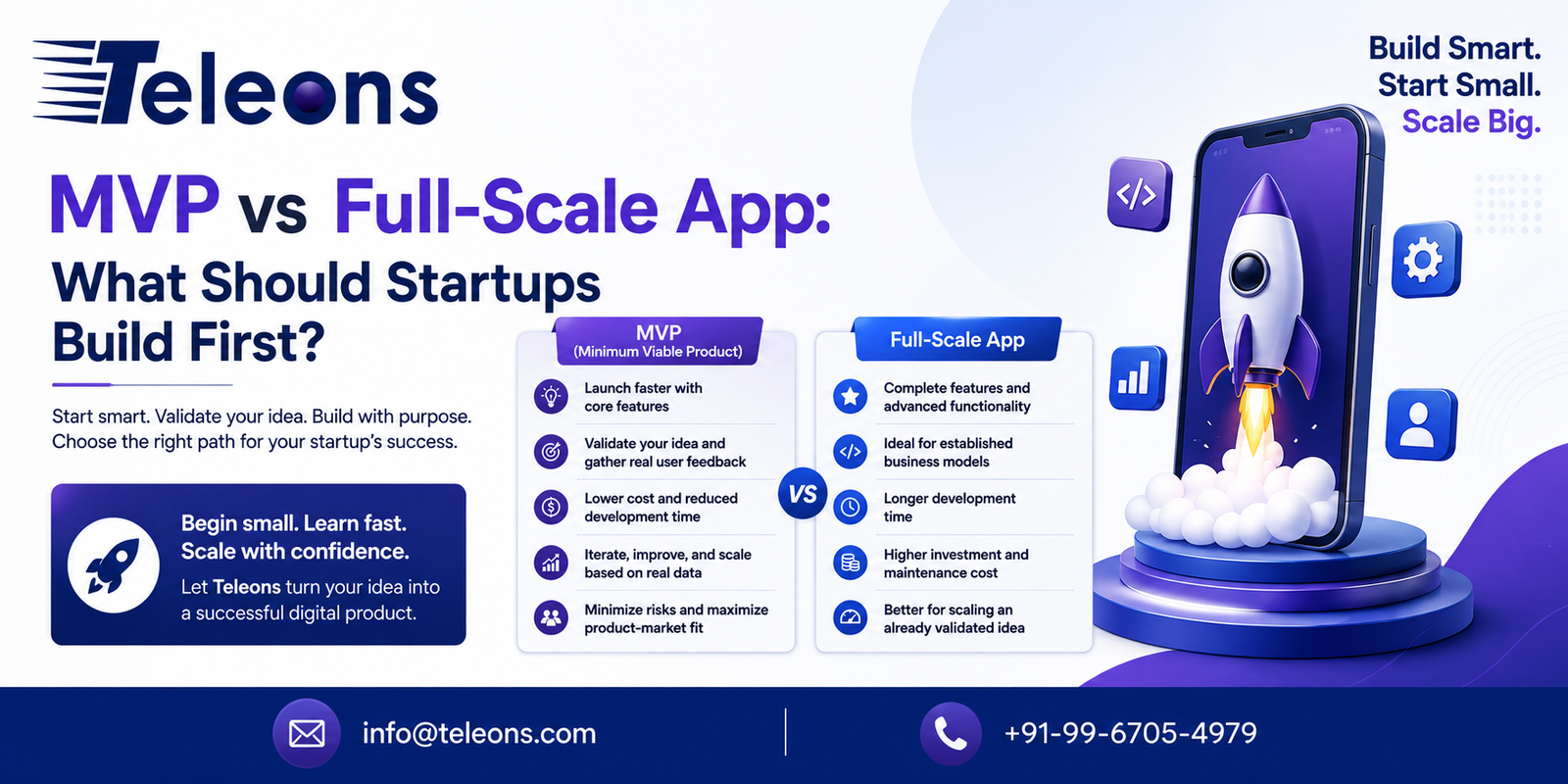
For startups, building a mobile or web application is not simply about creating as many features as possible. It is about finding the right balance between speed, cost, user needs, scalability, and long-term business goals. This is where the decision between a Minimum Viable Product (MVP) and a full-scale application becomes important.
For startups working with Teleons, an MVP can provide a practical way to validate an app idea before committing significant resources to a complete product. Instead of developing every planned feature from the beginning, startups can launch a focused version containing the essential functionality needed to solve a specific customer problem.
What Is an MVP?
A Minimum Viable Product is an initial version of an application that includes only the core features required to deliver value to users and test the business concept.
For example, if a startup wants to develop a food-delivery application, an MVP might include:
User registration
Restaurant listings
Food selection
Cart and checkout
Order tracking
Basic notifications
Advanced loyalty programs, AI recommendations, complex analytics, multiple payment options, and other features can be introduced later based on user feedback.
What Is a Full-Scale Application?
A full-scale app is a more comprehensive product developed with a broader set of features, integrations, user roles, security requirements, and scalability considerations.
It may include:
Advanced personalization
Multiple payment gateways
AI-powered recommendations
Detailed analytics
Third-party integrations
Loyalty and rewards
Advanced notifications
Multi-language support
Enterprise-level security
Administrative dashboards
A full-scale application can provide a richer user experience, but it generally requires more time, development resources, testing, and investment.
MVP vs Full-Scale App
Factor MVP Full-Scale App
Development Time Faster Longer
Initial Investment Lower Higher
Features Core functionality Comprehensive functionality
Market Testing Excellent Usually performed after extensive development
User Feedback Collected early Collected after larger development
Risk Lower initial risk Higher initial investment risk
Scalability Built progressively Planned extensively from the beginning
Updates Based on feedback Broader feature roadmap
Best For Testing an idea Mature or validated concepts
Why Startups Often Begin With an MVP
1. Validate the Business Idea
An MVP allows startups to determine whether customers actually need the proposed product. Instead of assuming that users will adopt a particular feature, businesses can launch a functional product and observe real-world behavior.
2. Reduce Initial Development Costs
Developing a complete application can require considerable resources. Starting with essential functionality allows startups to control their initial investment and allocate resources toward features that demonstrate genuine market demand.
3. Get Real User Feedback
User feedback is extremely valuable during the early stages of product development. An MVP allows startups to learn what users like, what they struggle with, and which features they expect next.
4. Launch Faster
A focused product can reach the market faster than a large application containing dozens of features. Early market entry gives startups an opportunity to test their concept and learn before competitors or market conditions change.
5. Build Based on Evidence
Instead of developing a complete roadmap based entirely on assumptions, startups can use MVP data to determine what should be built next. This creates a more evidence-based product development process.
When Should a Startup Build a Full-Scale App?
An MVP is not always the answer. A startup may need a more complete application from the beginning when the product requires complex infrastructure, regulatory compliance, advanced security, multiple interconnected systems, or a sophisticated user experience to function properly.
For example, applications involving financial transactions, healthcare workflows, enterprise systems, or complex logistics may require more comprehensive architecture and testing before launch.
A Better Approach: MVP With a Scalable Foundation
Choosing an MVP does not mean building a low-quality application. The better strategy is to keep the feature set focused while maintaining a strong technical foundation.
Startups can build the essential functionality first while designing the architecture so additional features can be incorporated later. This approach helps avoid unnecessary development while keeping the product prepared for future growth.
How Teleons Can Help Startups
Teleons can support startups through the app development journey, from understanding the product concept and defining core functionality to developing, testing, and improving the application. A structured development approach can help startups prioritize features, validate their ideas, and progressively expand their products as user demand increases.
Final Thoughts
For most startups, the question is not simply “MVP or full-scale app?” The more important question is “What is the smallest useful product we can build without limiting future growth?”
An MVP can help validate the idea, understand users, control initial investment, and establish a foundation for future development. Once the product gains traction and the business understands its customers better, additional features can be introduced strategically.
Start small, learn quickly, and scale based on real demand.
Have an App Idea? Start Smart With Teleons
Don’t invest heavily in features your customers may not need. Teleons can help you transform your concept into a focused, scalable application designed around real business objectives.
Build your MVP, validate your idea, and scale your app with confidence. Contact Teleons today.
Website: Teleons
Phone: +91-99-6705-4979
Email: info@teleons.com
FAQs
1. Is an MVP better than a full-scale app for startups?
An MVP can be a practical starting point for many startups because it allows them to validate their idea, gather user feedback, and control initial development costs before investing in a larger product.
2. How many features should an MVP have?
An MVP should contain the minimum set of features required to solve the primary customer problem and provide a usable experience. The exact number depends on the application and its business objectives.
3. Does building an MVP mean compromising on quality?
No. An MVP should have a focused feature set, but it should still provide a reliable, secure, and user-friendly experience. Quality should not be sacrificed simply to launch quickly.
4. When should a startup move from an MVP to a full-scale application?
Startups can consider expanding when they have validated their product idea, established consistent user demand, identified important additional features, and developed a clearer understanding of their market.
5. Can an MVP be scaled later?
Yes. When the initial application is developed with a scalable architecture, startups can progressively add features, integrations, users, and infrastructure as the business grows.
6. How does Teleons help startups build apps?
Teleons can help startups with app development by supporting the product development process, feature planning, application development, testing, and ongoing improvements based on business and user requirements.


Related Posts
Automate Repetitive Tasks With Custom Software
Introduction Every business has routine tasks that need to be completed daily, from managing customer enquiries and sending emails to updating records, scheduling appointments, and…
Read More
App Store Optimization: How to Get More App Downloads
Building a mobile app is only the first step. The next challenge is getting people to discover, download and use it. With thousands of apps…
Read More