




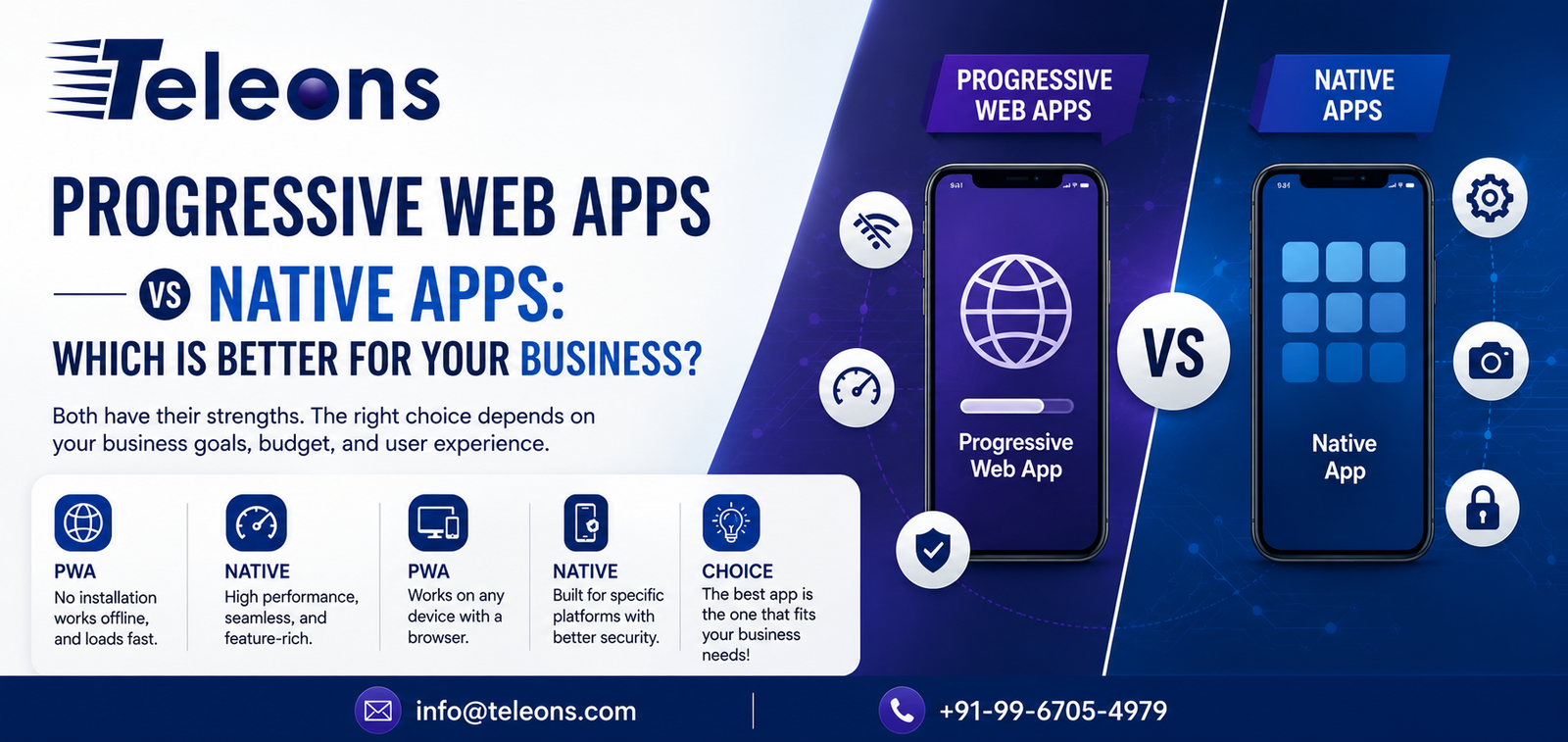
Businesses today need to provide customers with fast, reliable, and convenient digital experiences. Mobile applications are one of the most effective ways to stay connected with customers, but choosing the right app technology can be challenging.
Two popular options are Progressive Web Apps (PWAs) and Native Apps. Both can provide excellent user experiences, but they serve different business requirements.
A PWA runs through a web browser while offering many app-like features. A native app, on the other hand, is specifically developed for an operating system such as Android or iOS.
So, which option is better for your business? The answer depends on your target audience, budget, features, performance requirements, and long-term goals.
What Is a Progressive Web App?
A Progressive Web App is a web application designed to provide an experience similar to a mobile application.
Users can access a PWA through a browser without necessarily downloading it from an app store. Depending on its implementation and platform support, a PWA can offer features such as installation to the device, offline or limited-connectivity experiences, push notifications, and access to certain device capabilities.
PWAs can be particularly useful for businesses that want to make their digital services easily accessible across devices.
What Is a Native App?
A native app is developed specifically for a particular operating system.
For example, Android applications are typically developed using technologies such as Kotlin or Java, while iOS applications can be built using Swift or Objective-C.
Because native apps are designed specifically for their target platforms, they can provide strong performance and access to platform-specific capabilities.
Native applications are often preferred for products that require advanced device integration, intensive processing, or highly customized mobile experiences.
Progressive Web Apps vs Native Apps
Factor Progressive Web Apps Native Apps
Installation Can be accessed through a browser and may be installable Usually installed through app stores
Development Can support multiple platforms from a web technology base Usually requires platform-specific development
Performance Generally good, depending on the application Typically excellent for platform-specific workloads
Offline Experience Possible with appropriate implementation Strong offline capabilities can be built
Device Features Depends on browser and platform support Broad access to native device capabilities
Updates Web-based updates can be deployed without traditional app-store releases Updates generally go through app distribution channels
App Store Presence Not necessarily required Usually distributed through app stores
Best For Broad web accessibility and simpler experiences Feature-rich, platform-specific applications
Benefits of Progressive Web Apps
1. Easy Accessibility
Users can access a PWA through a web browser, which can reduce the friction associated with downloading an application.
This can be useful for businesses trying to reach users quickly.
2. Cross-Platform Reach
A well-built PWA can work across different devices and operating systems through compatible browsers, allowing businesses to maintain a broader reach without building completely separate applications for every platform.
3. Lower Development Complexity
For some projects, a PWA can reduce the need to maintain separate native applications. This can make development and maintenance more straightforward, depending on the required features.
4. Faster Content and Feature Updates
Because PWAs are web-based, businesses can often deploy updates directly to the web application rather than depending entirely on traditional app-store update cycles.
5. Discoverability Through Search
PWAs are based on web technologies, so businesses can potentially use SEO and other web marketing strategies to attract users.
This can be particularly useful for businesses that depend heavily on organic search traffic.
Benefits of Native Apps
High Performance
Native applications can take advantage of platform-specific technologies and optimization techniques, making them suitable for applications that require high performance.
Better Access to Device Features
Native development can provide broader access to platform capabilities such as cameras, sensors, Bluetooth, location services, biometrics, and other device functionality, subject to operating-system permissions and policies.
Rich User Experience
Native apps can closely follow the design patterns and interaction behaviours of their respective platforms.
This can help create a polished and familiar experience for users.
Advanced Functionality
Applications involving gaming, media processing, financial workflows, advanced graphics, or complex device integrations may benefit from native development.
Strong App Ecosystem Integration
Native apps can integrate closely with platform features and distribution ecosystems, which can be valuable for businesses planning a long-term mobile product.
Which Is More Cost-Effective?
The development cost depends heavily on the complexity of the application.
A relatively simple business application may be more economical to launch as a PWA because one web-based solution can potentially serve multiple platforms.
However, if the application requires advanced native functionality, investing in native development may provide better long-term value.
Businesses should evaluate total cost of ownership, including development, maintenance, testing, updates, infrastructure, and future feature requirements.
Which Offers Better Performance?
Native apps generally have an advantage when maximum platform-specific performance is required.
However, modern PWAs can deliver fast and responsive experiences when they are properly designed, optimized, and supported by the target browser environment.
For a content-driven business, service platform, online store, or customer portal, a PWA may provide sufficient performance.
For resource-intensive applications, native development may be more appropriate.
Which Is Better for User Engagement?
Native apps can provide deeper integration with mobile operating systems and can support engagement features such as push notifications where supported and appropriately implemented.
PWAs can also provide app-like experiences and engagement features, but available capabilities vary by browser and operating system.
Therefore, the right choice depends on how heavily your business relies on mobile engagement and device-specific functionality.
When Should Your Business Choose a PWA?
A PWA may be a good option if:
You want broad device accessibility.
Your application is primarily web-based.
SEO and web discoverability are important.
You want to launch an MVP quickly.
Your application doesn’t require extensive native functionality.
You want a single web technology base for multiple platforms.
You want users to access your product without relying exclusively on app-store downloads.
When Should Your Business Choose a Native App?
Native development may be better if:
Your application requires advanced device capabilities.
Performance is a major priority.
You need complex animations or graphics.
Your product depends heavily on platform-specific functionality.
You want a highly customized mobile experience.
Your business plans to build a long-term mobile ecosystem.
PWA vs Native App: How Should You Decide?
Instead of choosing based purely on technology trends, evaluate your business requirements.
Ask:
Who are your users?
Understand whether they primarily access your service through mobile browsers, apps, desktops, or a combination.
What features do you need?
List the device capabilities and integrations your application requires.
What is your budget?
Consider both initial development and ongoing maintenance.
How important is SEO?
If organic search is a major acquisition channel, a web-based experience may offer important advantages.
How important is native performance?
If your product requires intensive processing or advanced device integration, native development may be worth the investment.
Can You Combine Both Approaches?
Yes. Businesses don’t necessarily have to choose one technology forever.
A company might begin with a PWA to validate its idea and reach customers quickly. Once the product gains traction and more advanced functionality is required, the business can consider developing native applications.
The right technology can also vary by product, audience, and business stage.
How Teleons Can Help
Choosing between a PWA and native app requires a clear understanding of your business goals, users, technical requirements, and future growth plans.
Teleons can help businesses evaluate their requirements and develop mobile and web solutions aligned with their digital strategy. Whether you need a web application, Android app, iOS app, or a broader digital product, choosing the right development approach at the beginning can help reduce unnecessary costs and create a better user experience.
Conclusion
There is no universal winner between Progressive Web Apps and Native Apps.
PWAs can be an excellent choice for businesses that prioritize web accessibility, cross-platform reach, discoverability, and efficient development. Native apps can be a better fit for businesses that need high performance, advanced device integration, and highly customized mobile experiences.
The best approach is to start with your business objectives and user requirements, then select the technology that supports them.
Not Sure Whether Your Business Needs a PWA or Native App?
Choosing the right technology can influence your development costs, user experience, scalability, and long-term growth.
Teleons helps businesses plan and develop digital products based on their specific goals and technical requirements. Whether you’re looking for PWA development, Android app development, iOS app development, or web application development, our team can help you choose the right approach.
Contact Teleons today to discuss your app idea and build a digital solution designed for your business.
Company Name: Teleons
Website: https://teleons.com/
Phone: +91-99-6705-4979
Email: info@teleons.com
FAQs
1. What is the difference between a PWA and a native app?
A PWA is a web application that can provide an app-like experience through compatible browsers, while a native app is developed specifically for an operating system such as Android or iOS.
2. Are PWAs better than native apps?
Not necessarily. PWAs can be better for accessibility and web-based experiences, while native apps can be better for advanced device functionality and platform-specific performance.
3. Are Progressive Web Apps cheaper to develop?
They can be more cost-effective for certain projects because a web technology base can serve multiple platforms. Actual costs depend on application complexity and required functionality.
4. Can PWAs work offline?
PWAs can support offline or limited-connectivity experiences when they are designed with appropriate caching and service-worker strategies. The exact experience depends on the application’s architecture and browser support.
5. Are native apps faster than PWAs?
Native apps generally provide an advantage for intensive, platform-specific workloads. However, a well-optimized PWA can still provide a fast and responsive experience for many business applications.
6. Can a PWA send push notifications?
Push notification capabilities depend on the browser, operating system, permissions, and implementation. Support has expanded considerably, but businesses should verify compatibility for their target audience.
7. Which is better for an eCommerce business?
Either option can work. A PWA may be useful for businesses focused on web discovery and broad accessibility, while a native app can be valuable when frequent engagement and deeper mobile-device integration are priorities.
8. Should a startup build a PWA or native app first?
It depends on the product. A startup may consider a PWA when it wants to validate a web-based product quickly, while native development may make more sense when the core product depends on advanced mobile functionality.


Related Posts
App Store Optimization: How to Get More App Downloads
Building a mobile app is only the first step. The next challenge is getting people to discover, download and use it. With thousands of apps…
Read More
How Mobile Apps Help Businesses Improve Customer Engagement
Introduction Customer engagement has become a critical factor in building a successful business. Customers today expect brands to be accessible, responsive, personalized, and convenient across…
Read More