




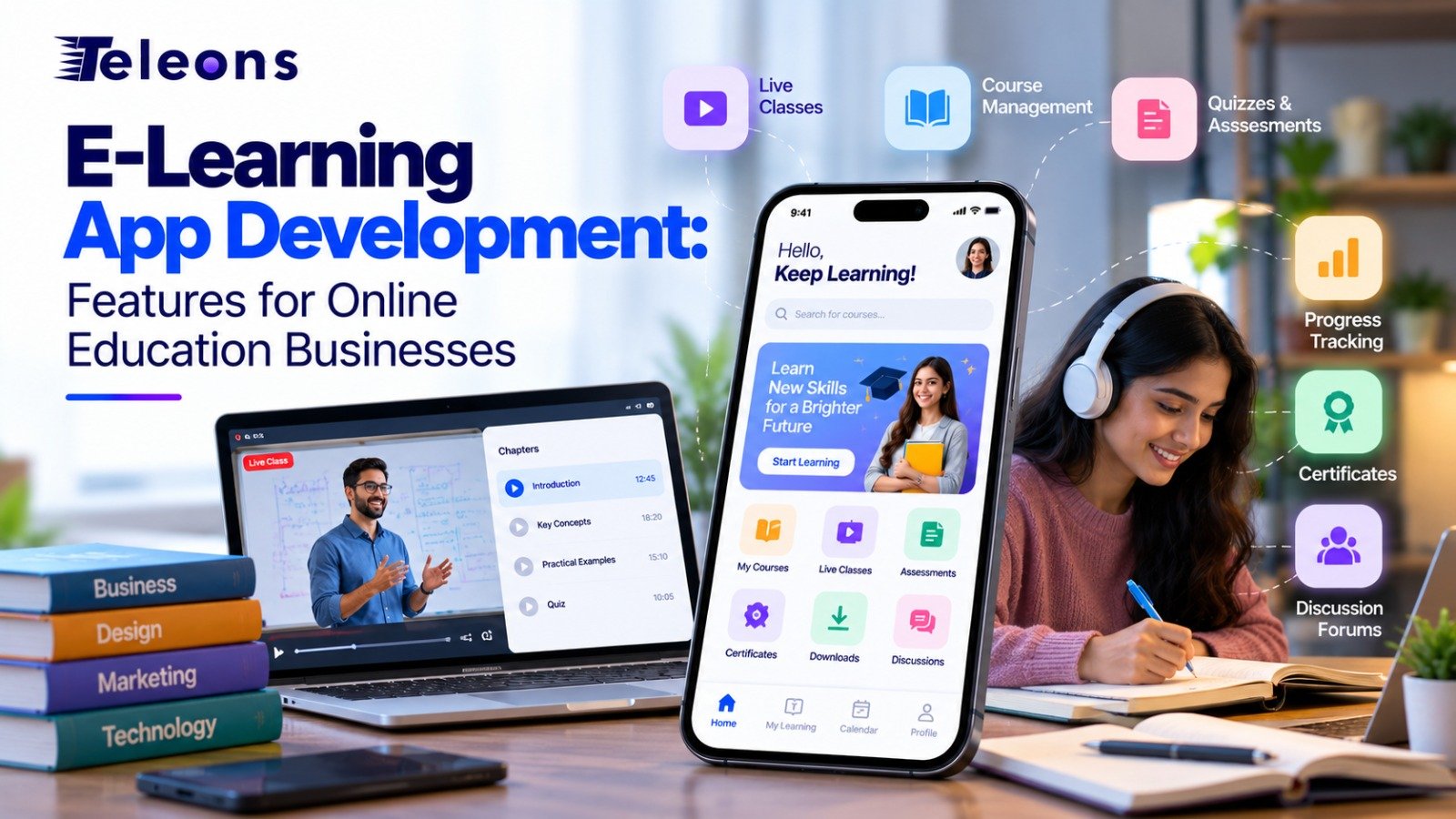
Introduction
Digital education has transformed how students learn, professionals develop new skills, and businesses deliver training. Online education platforms now allow learners to access courses, attend virtual classes, complete assessments, and track their progress from almost anywhere.
For education businesses, this shift creates opportunities to reach wider audiences, expand course offerings, and build more flexible learning experiences.
However, launching a successful e-learning platform involves more than uploading videos and creating user accounts. Businesses need an application that supports structured learning, engaging content, reliable performance, convenient access, and measurable learner progress.
At Teleons, we help businesses develop custom web and mobile applications tailored to their operational needs and digital goals.
This article explores the essential features of e-learning app development and how online education businesses can use technology to create effective digital learning experiences.
What Is E-Learning App Development?
E-learning app development refers to creating digital applications that deliver educational content, training programs, assessments, and learning activities through mobile devices or web browsers.
These applications can support different education models, including:
Online coaching and tutoring
School and college learning
Professional skill development
Corporate employee training
Certification programs
Language learning
Self-paced online courses
Depending on the business model, an e-learning application may serve students, teachers, instructors, administrators, or corporate training teams.
The primary objective is to make learning accessible, organized, interactive, and convenient while helping education providers manage their programs efficiently.
Essential Features of an E-Learning Application
1. User Registration and Role-Based Access
An e-learning application should provide a straightforward registration and login experience.
Different users require different functionality, so the application should support appropriate roles and permissions.
Common user roles include:
Students and learners
Teachers and instructors
Course administrators
Content managers
For example, students may access enrolled courses and assessments, while instructors manage course content and monitor learner progress.
Role-based access helps organize the platform and ensures users can access the features relevant to their responsibilities.
2. Course Management System
Course management is a core feature of any online education platform.
Businesses should be able to organize educational content into structured courses, modules, and lessons.
A course management system can support:
Course creation and editing
Video and document uploads
Lesson sequencing
Course categorization
Learning objectives
Course prerequisites
Enrollment management
A structured course experience helps learners understand what they need to study and how different lessons relate to one another.
3. Live Classes and Virtual Learning
Live classes allow instructors to interact with learners in real time.
An e-learning application can integrate with supported video conferencing services or provide live learning functionality through appropriate technology.
Useful capabilities include:
Live video sessions
Scheduled classes
Instructor announcements
Learner participation
Session recordings
Attendance tracking
For coaching institutes and training businesses, live classes can complement recorded content and support interactive learning.
4. Recorded Video Lessons
Recorded lessons allow learners to study according to their own schedules.
A video learning system should provide:
Organized video lessons
Playback controls
Lesson completion tracking
Video quality options
Captions or subtitles
Access to previously recorded sessions
Where permitted by the course structure, learners may also benefit from bookmarking lessons or resuming videos from their last viewing position.
For businesses offering large video libraries, efficient media delivery and content protection measures are important development considerations.
5. Assessments, Quizzes, and Assignments
Assessments help education providers evaluate learner understanding.
An e-learning application can include:
Multiple-choice quizzes
True-or-false questions
Descriptive assignments
Timed assessments
Automated scoring
Instructor-reviewed submissions
Assessment history
These features allow learners to practice concepts and understand their progress.
For certification or high-stakes examinations, additional controls may be required to support assessment integrity.
6. Learner Progress Tracking
Learners benefit from understanding how much of a course they have completed and what they should study next.
Progress tracking can include:
Course completion percentage
Lessons completed
Assessment scores
Learning activity history
Pending assignments
Course milestones
For instructors and administrators, progress dashboards can help identify learners who may need additional support.
The information should be presented clearly so that both learners and educators can make informed decisions about the learning process.
7. Student and Instructor Dashboards
A well-designed e-learning application should provide separate dashboards for different users.
Student Dashboard
Students may access:
Enrolled courses
Upcoming live classes
Pending assignments
Recent assessment results
Learning progress
Course announcements
Instructor Dashboard
Instructors may manage:
Course content
Class schedules
Learner submissions
Attendance
Assessment results
Student progress
A dashboard that prioritizes relevant information can reduce unnecessary navigation and make daily learning activities easier to manage.
8. Notifications and Reminders
Notifications help learners stay informed about important learning activities.
An e-learning application can send notifications for:
Upcoming live classes
Assignment deadlines
New course materials
Assessment schedules
Instructor announcements
Course enrollment updates
Notifications should be timely and relevant rather than excessive.
For example, a learner may receive a reminder before a scheduled class or when a new lesson becomes available.
9. Secure Payments and Course Enrollment
For businesses selling online courses, payment and enrollment functionality is essential.
A platform may support:
Course purchases
Subscription plans
Payment gateway integration
Enrollment confirmation
Digital invoices or receipts
Refund request workflows
Payment functionality should be designed around the business model and supported payment providers.
After a successful payment, the application should update enrollment status and provide the learner with access to the appropriate course.
10. Certificates and Learning Achievements
Education businesses often provide certificates to learners who complete a course or training program.
Certificate functionality can include:
Completion criteria
Certificate generation
Learner names and course details
Completion dates
Certificate verification
Downloadable certificates
Certificates should be issued only when the learner meets the requirements defined by the education provider.
For professional training and certification businesses, certificate verification can help establish the authenticity of issued credentials.
Advanced Features for Modern E-Learning Platforms
Beyond essential functionality, businesses may consider advanced features that improve accessibility, engagement, and learning management.
AI-Powered Learning Recommendations
Artificial Intelligence can help personalize learning experiences.
Possible applications include:
Course recommendations
Suggested lessons
Learning content discovery
Practice question recommendations
Automated content categorization
AI recommendations should be based on appropriate learner information and should complement, rather than replace, educational guidance.
Interactive Learning Experiences
Interactive content can make learning more engaging than passive video consumption.
Features may include:
Interactive quizzes
Flashcards
Simulations
Educational games
Discussion activities
Practical exercises
These experiences can encourage learners to actively participate in the course material.
Discussion Forums and Community Learning
Community features allow learners to interact beyond scheduled classes.
An e-learning platform may include:
Course discussion forums
Question-and-answer sections
Peer learning groups
Instructor feedback
Moderated discussions
These features can support collaboration and help learners share knowledge.
Offline Learning and Content Downloads
Learners may not always have reliable internet access.
Depending on content licensing and security requirements, an e-learning application can allow selected lessons or documents to be downloaded for offline use.
Offline functionality should include appropriate access controls, content expiry where required, and synchronization when connectivity returns.
How E-Learning Apps Benefit Online Education Businesses
1. Reach a Wider Audience
A digital learning platform allows education providers to serve students beyond their immediate geographical area.
Businesses can offer courses to learners across cities, regions, and potentially international markets, subject to their operational and regulatory requirements.
2. Expand Course Offerings
An online education business can introduce additional courses, learning paths, or subscription plans without relying entirely on physical classroom capacity.
This creates opportunities to diversify educational services.
3. Improve Learning Management
Digital course management, automated notifications, attendance records, and assessment workflows can reduce manual administrative work.
A centralized application can help instructors and administrators manage their educational programs more efficiently.
4. Understand Learner Behaviour
Learning analytics can help education businesses understand:
Which lessons learners complete
Where learners stop progressing
Which assessments are difficult
How learners interact with content
Which courses receive the most engagement
These insights can help providers identify areas where course content or the learning experience may need improvement.
5. Create Flexible Revenue Models
E-learning platforms can support different commercial models, including:
Individual course purchases
Monthly or annual subscriptions
Paid certification programs
Corporate training packages
Membership-based learning
The appropriate model depends on the target audience, course structure, and business objectives.
E-Learning App Development: Important Technical Considerations
A successful education application requires a reliable technical foundation.
Responsive and Accessible Design
Learners may access educational content through smartphones, tablets, laptops, or desktop computers.
A responsive interface should provide consistent navigation and readable content across screen sizes.
Accessibility considerations include keyboard navigation, readable typography, captions, appropriate contrast, and compatibility with assistive technologies.
Performance and Video Delivery
Video content can account for a substantial portion of an e-learning platform’s infrastructure requirements.
Businesses should consider:
Efficient video delivery
Appropriate video compression
Content delivery networks
Scalable media storage
Reliable playback
Network-dependent quality adjustments
These considerations can help maintain a consistent learning experience as the number of learners increases.
Security and Data Protection
E-learning platforms may store personal information, educational records, assessment results, and payment-related data.
Important safeguards include:
Secure authentication
Role-based access controls
Data encryption
Secure API communication
Appropriate backups
Security testing
Education providers should also identify applicable privacy, child protection, and data retention requirements based on their users and operating locations.
Scalability
An application that serves a small group of learners may eventually need to support thousands of users, additional courses, and simultaneous live classes.
Scalable architecture, efficient database design, and appropriate cloud infrastructure can help accommodate growth.
Teleons E-Learning App Development Services
At Teleons, we develop custom web and mobile applications based on business requirements and user needs.
Our development services can support online education businesses through:
1. Custom E-Learning Application Development
We develop applications for online coaching, training providers, education businesses, and digital learning platforms.
The application scope can include course management, student accounts, learning dashboards, assessments, and other required educational features.
2. UI/UX Design for Digital Learning
We focus on creating intuitive interfaces that help learners navigate courses, access lessons, complete assessments, and understand their progress.
3. API and Third-Party Integrations
Depending on the project requirements, e-learning applications can integrate with:
Video conferencing services
Payment gateways
Email and notification systems
Learning management tools
Analytics platforms
Business management software
4. Testing and Ongoing Maintenance
We support application testing, troubleshooting, performance optimization, and maintenance to help businesses keep their digital learning platforms reliable.
The development approach depends on the application’s complexity, expected users, content requirements, and integration needs.
Conclusion
E-learning app development provides online education businesses with an opportunity to deliver flexible, accessible, and organized learning experiences.
Features such as course management, live classes, recorded lessons, assessments, learner dashboards, payments, and progress tracking form the foundation of a modern digital learning platform.
Advanced capabilities such as AI-powered recommendations, interactive learning, offline access, and analytics can further improve the learning experience when they address genuine learner and business needs.
However, the success of an e-learning application depends on more than the number of features it offers. Businesses should prioritize usability, educational value, security, reliable performance, and scalability.
Looking to develop an e-learning application for your education business?
Teleons helps businesses explore custom web and mobile application development solutions tailored to their requirements.
Company: Teleons
Location: Mumbai, India
Website: https://teleons.com/
Phone: +91-99-6705-4979
Email: info@teleons.com
Contact Teleons to discuss your e-learning app idea and explore a development approach aligned with your educational and business objectives.
Frequently Asked Questions
1. What are the essential features of an e-learning app?
Common features include user registration, course management, video lessons, live classes, assessments, progress tracking, notifications, payments, and student dashboards.
2. How much does e-learning app development cost?
The cost depends on the application scope, number of platforms, video infrastructure, integrations, user roles, and advanced features. A basic course application generally requires a different development effort from a comprehensive learning management system.
3. How long does it take to develop an e-learning app?
Development timelines depend on the number of features, content delivery requirements, design complexity, integrations, and testing. A clearly defined initial feature set can help establish a realistic project schedule.
4. Can an e-learning app support both live and recorded classes?
Yes. An application can provide recorded lessons and integrate live video sessions, allowing education businesses to offer both self-paced and instructor-led learning.
5. Can e-learning apps provide certificates?
Yes. Applications can generate completion certificates based on predefined course requirements, assessment results, or other completion criteria.
6. Why choose custom e-learning app development?
Custom development allows education businesses to create learning workflows, course structures, user experiences, integrations, and commercial models that align with their specific requirements.


Related Posts
Fintech App Development: Essential Features for Modern Financial Services
Introduction The financial services industry is undergoing a major digital transformation. Customers increasingly expect to manage their money, make payments, transfer funds, access financial information,…
Read More
Why Do Mobile Apps Fail? Common Mistakes Businesses Can Avoid
Mobile apps have become an important part of how businesses connect with customers, deliver services, and grow their digital presence. From e-commerce and healthcare to…
Read More