




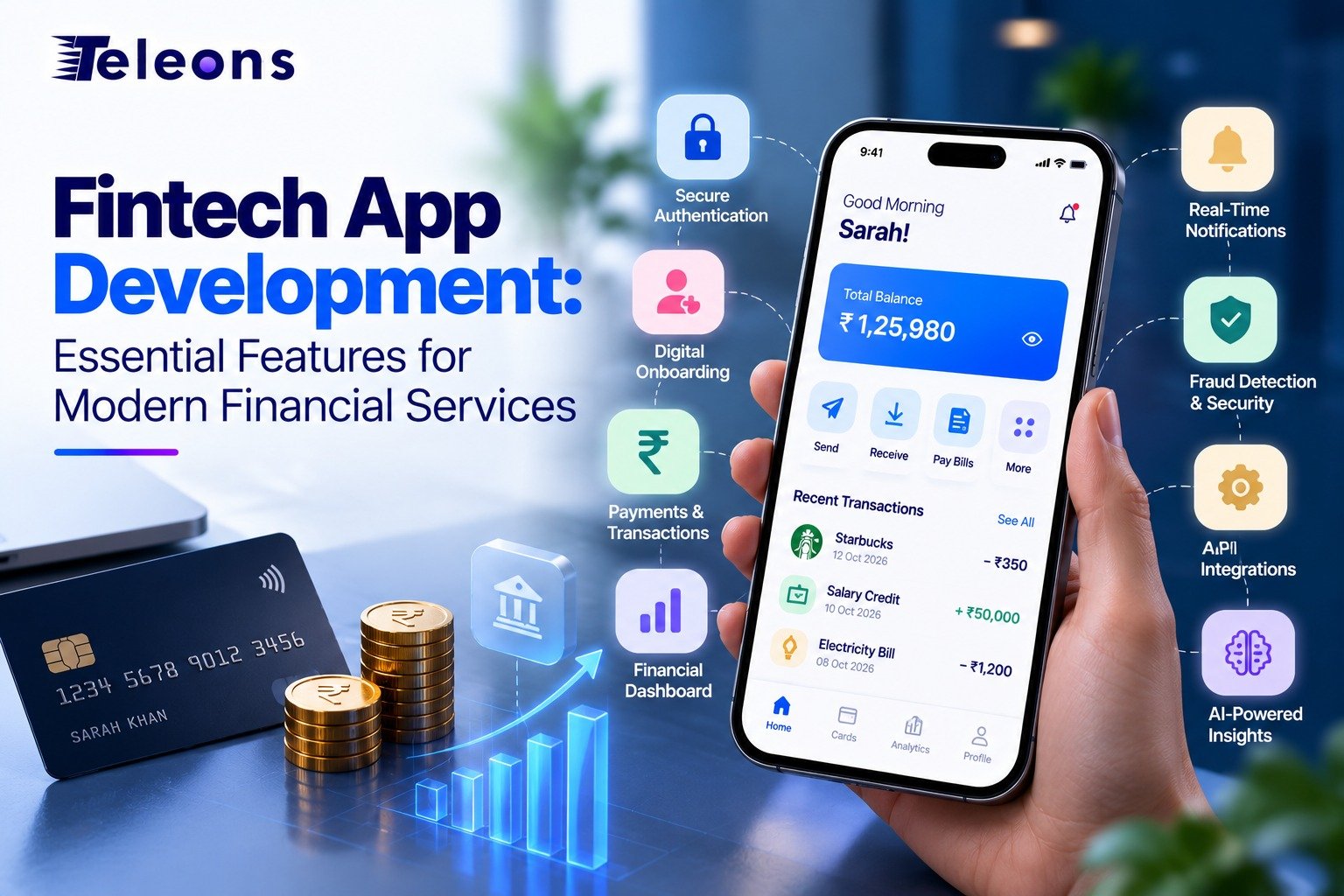
Introduction
The financial services industry is undergoing a major digital transformation. Customers increasingly expect to manage their money, make payments, transfer funds, access financial information, and apply for services through convenient digital platforms.
Traditional banking processes and manual financial operations are gradually being supplemented by mobile applications and web-based financial solutions. These applications help financial businesses deliver faster services, improve accessibility, and create more convenient customer experiences.
However, developing a successful fintech application involves more than building a digital interface. Financial applications must combine security, reliability, performance, regulatory considerations, and intuitive user experiences.
At Teleons Software, we help businesses develop custom software and mobile applications designed around their operational requirements and customer needs.
This article explores the essential features of modern fintech applications and how businesses can approach fintech app development.
What Is Fintech App Development?
Fintech app development refers to creating software applications that use technology to deliver or improve financial services.
These applications can support various activities, including:
Digital payments and money transfers
Online banking and account management
Personal finance management
Investment and portfolio tracking
Insurance services
Lending and loan management
Business financial operations
Depending on the business model, a fintech application may serve individual consumers, financial institutions, merchants, or businesses.
The objective is to simplify financial activities while providing customers with secure, accessible, and reliable digital services.
Essential Features of Modern Fintech Applications
1. Secure User Authentication
Security is one of the most important requirements for financial applications.
A fintech app should provide appropriate authentication mechanisms to help prevent unauthorized access to user accounts.
Depending on the application’s risk profile, features may include:
Multi-factor authentication
Biometric authentication
Secure login and session management
Password recovery
Device verification
Suspicious login alerts
Authentication requirements should be designed around the sensitivity of financial transactions and applicable security standards.
2. Digital Customer Onboarding
Digital onboarding allows customers to register and access financial services without completing every step through physical paperwork or branch visits.
A streamlined onboarding experience may include:
Online registration
Customer information collection
Identity verification
Document submission
Application status tracking
Account activation
For financial services that require identity verification, onboarding workflows must incorporate appropriate verification procedures and applicable regulatory requirements.
A simple, well-organized onboarding journey can reduce friction and make it easier for customers to begin using the application.
3. Real-Time Transactions and Payments
Payment functionality is a core feature of many fintech applications.
Customers may need to transfer funds, make purchases, pay bills, or receive money through the application.
Important capabilities can include:
Payment initiation
Transaction confirmation
Payment history
Transaction status tracking
Digital receipts
Failed-payment handling
For India-focused applications, payment integrations may involve UPI, supported banking systems, payment gateways, or other authorized payment infrastructure, depending on the business model and eligibility.
Payment processing should prioritize transaction accuracy, clear status updates, and appropriate handling of duplicate requests or failed transactions.
4. Financial Dashboard and Account Management
A financial dashboard gives users a consolidated view of their financial information.
Depending on the application, the dashboard may display:
Account balances
Recent transactions
Income and expenses
Payment activity
Spending categories
Financial summaries
A clear dashboard helps users understand their financial activity without navigating through multiple screens.
The interface should present important information using readable typography, intuitive navigation, and a logical information hierarchy.
5. Transaction Notifications and Alerts
Timely notifications help users stay informed about financial activities.
A fintech application can provide alerts for:
Successful transactions
Failed payments
Account activity
Payment reminders
Upcoming bills
Security-related events
Notifications should be relevant and delivered through appropriate channels.
Sensitive financial information should not be unnecessarily exposed in notification previews, particularly on shared or locked devices.
6. Expense Tracking and Budgeting
Personal finance applications can help users understand their spending patterns and manage budgets.
Useful features include:
Expense categorization
Monthly spending summaries
Budget creation
Spending limit alerts
Recurring expense tracking
Financial goal tracking
For example, users may create a monthly budget and review how their expenses compare with their planned spending.
These features can make financial information easier to understand and support more informed financial decisions.
7. Fraud Detection and Risk Monitoring
Financial applications must be designed to identify and respond to potentially suspicious activity.
Depending on the financial service, risk monitoring can include:
Unusual transaction patterns
Multiple failed authentication attempts
Suspicious account activity
Unexpected transaction locations or devices
Abnormal transaction frequency
AI and machine learning may assist in identifying unusual patterns, but automated risk decisions require appropriate validation, monitoring, and human oversight where necessary.
A fintech application’s fraud prevention strategy should combine technical safeguards, risk policies, and operational procedures.
8. Customer Support and Dispute Management
Financial transactions can occasionally fail, be delayed, or require clarification.
A fintech app should make it easy for customers to seek assistance and track the progress of their requests.
Support functionality may include:
In-app customer support
Frequently asked questions
Support ticket creation
Transaction-related complaints
Dispute submission
Request status tracking
Clear communication and accessible support can help customers understand what happened and what action they should take next.
9. API and Third-Party Integrations
Modern fintech applications frequently rely on external systems to provide financial services.
Depending on the business model, integrations may connect the application with:
Banking systems
Payment gateways
Identity verification services
Accounting software
Financial data providers
Customer relationship management platforms
APIs allow these systems to exchange information and support connected financial workflows.
However, integrations must be designed with appropriate authentication, data protection, error handling, and transaction controls.
Advanced Features in Fintech App Development
Beyond essential functionality, businesses may consider advanced features that improve financial experiences.
AI-Powered Financial Insights
AI can help analyze financial activity and identify patterns.
Possible applications include:
Spending insights
Financial trend analysis
Personalized financial recommendations
Customer support assistance
Automated document classification
AI-generated insights should be presented transparently and should not be treated as guaranteed financial outcomes.
Open Banking and Financial Data Connectivity
Where supported and permitted, financial applications may connect with external financial accounts to provide consolidated financial information.
This can help users view multiple accounts, analyze spending, and understand their overall financial position.
Such functionality requires appropriate consent, secure data access, and compliance with applicable financial data-sharing requirements.
Smart Financial Reminders
Applications can provide reminders for recurring financial activities such as bill payments, loan repayments, subscription renewals, and scheduled transfers.
These reminders can help users manage their financial responsibilities more conveniently.
Security and Compliance Considerations for Fintech Apps
Financial applications handle sensitive personal and financial information. Security should therefore be incorporated throughout the development process rather than added after the application is built.
Important considerations include:
Data Encryption: Protect sensitive information during transmission and storage using appropriate encryption practices.
Access Controls: Limit access to financial information and application functions according to user permissions.
Secure APIs: Implement authentication, authorization, input validation, and appropriate rate limiting.
Transaction Integrity: Design payment and transfer workflows to prevent duplicate processing and maintain accurate transaction records.
Security Testing: Conduct security reviews, vulnerability assessments, and testing before and after launch.
Regulatory Requirements: Identify applicable financial, privacy, payment, and identity verification requirements based on the service, operating jurisdiction, and business model.
For fintech businesses operating in India, requirements may vary depending on whether the application provides payment services, lending, banking-related services, investment products, or other financial activities. Businesses should obtain appropriate legal and regulatory guidance before launching regulated financial functionality.
How to Choose the Right Fintech App Development Approach
Before beginning development, businesses should define their application requirements.
1. Identify the Target Audience
Determine whether the application will serve consumers, merchants, financial institutions, or business users.
Different audiences require different workflows, permissions, and financial features.
2. Define the Core Financial Services
Identify the primary purpose of the application.
For example, a digital payment application requires transaction processing and payment security, while a personal finance application may prioritize expense tracking and financial dashboards.
3. Prioritize Security and Reliability
Security, data protection, and transaction accuracy should be considered during architecture and feature planning.
These requirements influence technology choices, integrations, testing, and operational processes.
4. Plan for Scalability
Fintech applications should be designed to accommodate changes in users, transaction volumes, integrations, and business requirements.
Scalable architecture and reliable infrastructure can help support future development.
5. Test the Complete Financial Workflow
Testing should cover more than the application’s visual interface.
Important scenarios include:
Successful and failed transactions
Network interruptions
Duplicate requests
Authentication failures
Account access restrictions
Data synchronization
Recovery from system errors
Testing these scenarios helps identify potential problems before customers depend on the application.
Teleons Software Fintech App Development Services
At Teleons Software, we develop custom mobile and web applications tailored to business requirements.
Our development approach can support fintech-related projects through:
Custom Application Development
Develop applications designed around specific financial workflows, customer requirements, and business objectives.
UI/UX Design
Create clear interfaces that help users navigate financial information, complete transactions, and manage their accounts.
API Integration
Connect applications with appropriate payment systems, external services, and business software.
Secure Software Architecture
Design applications with security, data protection, access control, and scalability in mind.
Testing and Maintenance
Support application testing, performance improvements, troubleshooting, and ongoing maintenance.
The exact scope of fintech development depends on the financial services offered, third-party integrations, and applicable regulatory requirements.
Conclusion
Fintech applications are becoming an important part of modern financial services. From digital onboarding and secure payments to financial dashboards and intelligent insights, the right features can make financial activities more accessible and convenient.
However, a successful fintech application must balance functionality with security, reliability, usability, and compliance.
Businesses should begin by identifying their customers’ financial needs, defining essential features, and designing an application that can evolve as those needs change.
Looking to develop a fintech application for your business?
Teleons Software helps businesses explore custom mobile and web application development solutions designed around their requirements.
Company: Teleons Software
Location: Mumbai, India
Website: https://Teleons Software.com/
Phone: +91-99-6705-4979
Email: info@Teleons Software.com
Contact Teleons Software to discuss your fintech application idea and explore a development approach aligned with your business goals.
Frequently Asked Questions
1. What are the essential features of a fintech app?
Common features include secure authentication, digital onboarding, payments, transaction history, financial dashboards, notifications, customer support, and fraud monitoring.
2. How much does fintech app development cost?
The cost depends on application complexity, platform requirements, security needs, integrations, and regulatory considerations. A basic financial management application generally requires a different development scope from a payment or lending platform.
3. How long does it take to develop a fintech app?
The timeline depends on the number of features, integrations, testing requirements, and the complexity of financial workflows. A clearly defined initial feature set can help establish a more realistic development schedule.
4. Is security important in fintech app development?
Yes. Financial applications handle sensitive information and transactions. Security measures such as encryption, access controls, secure APIs, authentication, and appropriate testing are fundamental requirements.
5. Can fintech applications integrate with banking systems?
Yes, depending on the service, available APIs, partner arrangements, permissions, and applicable regulations. Integration requirements should be evaluated during the planning stage.
6. Why choose custom fintech app development?
Custom development allows businesses to design financial workflows, user experiences, integrations, and application functionality around their specific requirements instead of relying entirely on a generic solution.


Related Posts

E-Learning App Development: Features for Online Education Businesses
Introduction Digital education has transformed how students learn, professionals develop new skills, and businesses deliver training. Online education platforms now allow learners to access courses,…
Read More
Why Do Mobile Apps Fail? Common Mistakes Businesses Can Avoid
Mobile apps have become an important part of how businesses connect with customers, deliver services, and grow their digital presence. From e-commerce and healthcare to…
Read More