




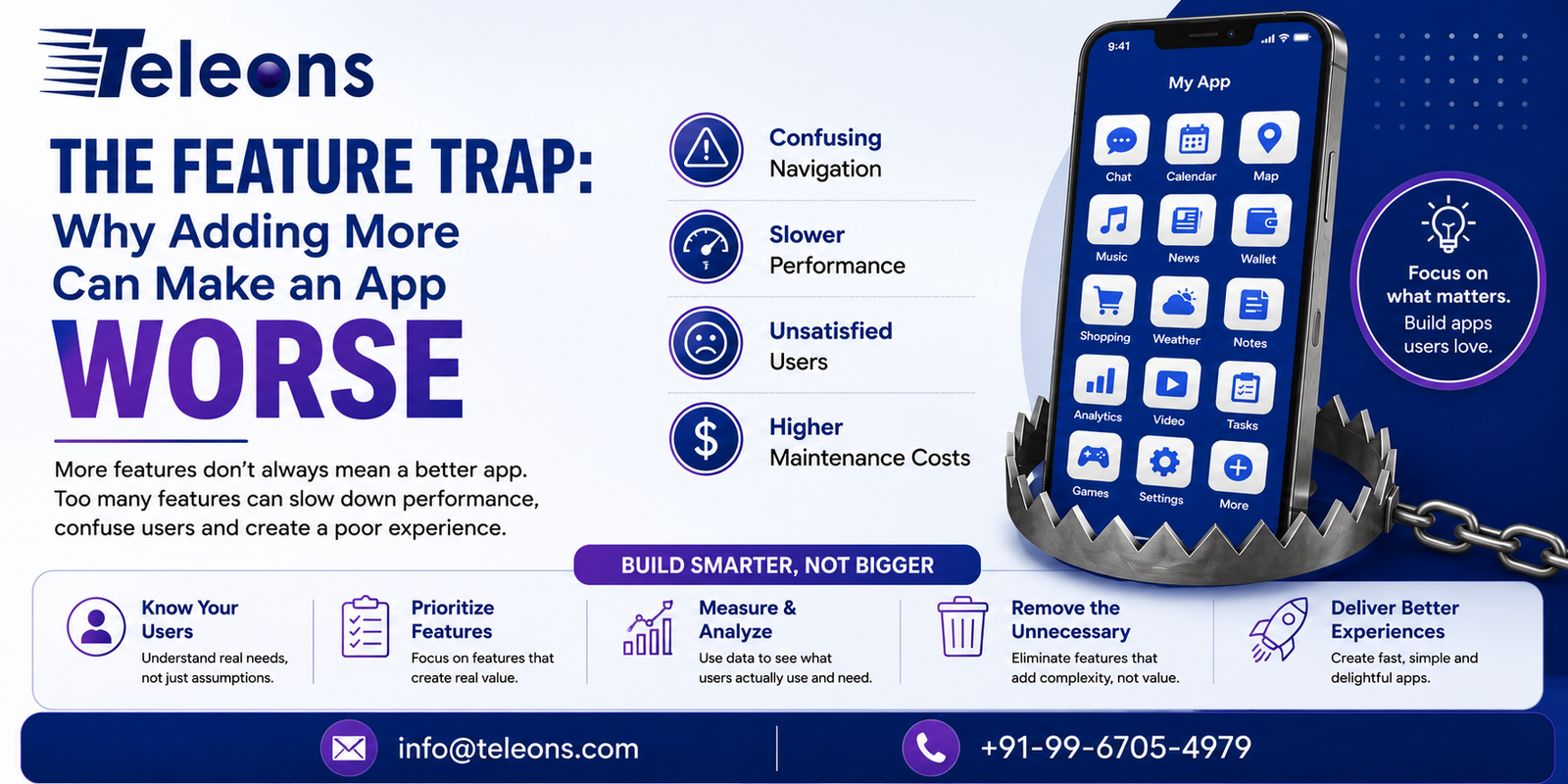
In app development, growth is often measured by how many features a product can offer. New integrations, dashboards, notifications, personalization options and advanced tools can make an app appear more powerful.
But more features don’t automatically create a better app.
In fact, continuously adding features can make an application slower, harder to understand, more expensive to maintain and less enjoyable to use. This is known as the feature trap—the tendency to keep adding functionality without considering whether users actually need it.
For businesses building mobile or web applications, knowing what not to build can be just as important as knowing what to build.
What Is the Feature Trap?
The feature trap happens when a product team keeps adding features because they believe more functionality will create more value.
A typical product roadmap might look like:
Core feature → New feature → Integration → Dashboard → AI tool → Notifications → More settings → More customization
Each addition may seem useful individually.
The problem appears when all these features exist together.
Users may suddenly have to navigate through complicated menus, understand unfamiliar options and make decisions they never wanted to make.
The application becomes more powerful—but less usable.
Why Do Businesses Keep Adding Features?
Feature expansion usually happens for understandable reasons.
Customer requests
Users frequently ask for additional functionality. Businesses naturally want to respond to those requests.
Competitive pressure
When a competitor launches a new feature, companies may feel they need to offer the same capability.
Internal ideas
Product teams often have ideas they genuinely believe will improve the product.
Technology availability
New technologies make it tempting to add capabilities simply because they are possible.
Fear of falling behind
Businesses sometimes assume that a product with fewer features looks outdated.
But feature quantity isn’t the same as product value.
More Features Can Create More Friction
Every feature introduces another interaction.
That may mean:
Another button
Another screen
Another menu
Another permission
Another setting
Another notification
Another learning requirement
Individually, these changes may appear insignificant.
Collectively, they can create digital friction.
A user who once needed two steps to complete a task may eventually need six or seven.
When this happens, the product becomes harder to use even though it technically offers more functionality.
Feature Creep Can Hurt User Experience
Feature creep is one of the most common challenges in product development.
Imagine a simple expense-management application.
Initially, users can:
Add an expense
Categorize it
View their spending
Over time, the product adds:
Investment tracking
Budget planning
Financial news
Credit-score monitoring
Bill reminders
Savings recommendations
Social sharing
Rewards
Multiple dashboards
The application may now be capable of much more.
But a user who simply wants to record an expense quickly may find the experience unnecessarily complicated.
The product has evolved from focused to overwhelming.
The Feature Does Not Matter If Users Don’t Use It
One of the most important questions product teams should ask is:
“How often will customers actually use this feature?”
A feature that takes months to develop but is used by only a tiny percentage of customers may not provide enough value to justify its development and maintenance costs.
Before building something new, businesses should consider:
How many users need it?
What problem does it solve?
How frequently will it be used?
Does it support the product’s primary purpose?
Will it make another workflow easier?
What will it cost to build?
What will it cost to maintain?
This shifts product development from feature accumulation to value creation.
Every Feature Has a Maintenance Cost
A feature doesn’t stop costing money after it is launched.
It may require:
Bug fixes
Security updates
Compatibility testing
Performance monitoring
Analytics
Documentation
Customer support
Design updates
Backend maintenance
Future development
The more features an application has, the larger its technical and operational footprint can become.
This is why product teams should consider the lifetime cost of a feature—not just the development cost.
More Features Can Slow Down an App
Complexity can also affect technical performance.
Additional functionality may introduce:
More API requests
Larger data loads
More database operations
Additional third-party services
More background processes
More code dependencies
If these components aren’t designed carefully, application performance can suffer.
Users generally don’t care how sophisticated the architecture is.
They care whether the app opens quickly, responds smoothly and lets them accomplish their goal without unnecessary delays.
The Feature Trap Can Increase Security Risks
Every additional component can potentially introduce another security consideration.
Third-party integrations, APIs, user permissions, data collection and authentication flows all need to be managed appropriately.
A highly complex application therefore has more areas that developers and security teams need to review.
This doesn’t mean businesses should avoid useful features.
It means each feature should justify the technical and security complexity it introduces.
Why Removing Features Can Improve an App
Product improvement doesn’t always mean adding something.
Sometimes the best improvement is removing something that isn’t helping users.
Removing unnecessary features can:
Simplify navigation
Improve performance
Reduce maintenance
Make onboarding easier
Reduce support requests
Improve usability
Reduce development complexity
This is why mature product teams often review existing features rather than only planning new ones.
The Difference Between Useful and Impressive
A feature can be impressive during a product demonstration but still provide little value to customers.
For example, an AI-powered dashboard might look impressive in a presentation.
But if customers only need a simple report, the additional complexity may not improve their experience.
The right question isn’t:
“Can we build this?”
It is:
“Will this make the user’s experience meaningfully better?”
That distinction can change an entire product roadmap.
How to Avoid the Feature Trap
Businesses can use a few practical principles to keep applications focused.
1. Start with the core problem
Define exactly what the application is supposed to help users accomplish.
2. Prioritize user outcomes
Evaluate features based on the outcome they create, not how technically impressive they appear.
3. Measure feature usage
Analytics can show whether users actually interact with a feature after launch.
4. Test before scaling
A feature can initially be released to a smaller group of users before becoming a major part of the application.
5. Review existing features
Product teams should periodically identify features that are rarely used or create unnecessary complexity.
6. Keep the primary journey simple
Users should be able to complete the application’s main task without navigating through unnecessary functionality.
Build for the User, Not the Feature List
A successful app isn’t necessarily the application with the longest list of features.
It is the application that helps users accomplish their goals quickly, clearly and reliably.
The best products often make complex technology feel simple.
That requires discipline.
Instead of asking what else can be added, product teams should regularly ask:
What can we simplify?
What can we remove?
What can we make easier?
Those questions can lead to a better application than another round of feature development.
The Future of App Development Is More Focused
As mobile and web applications become increasingly sophisticated, businesses have access to more technologies than ever before.
AI, automation, real-time data, cloud services and third-party integrations can all create powerful experiences.
But technology should serve the product—not define it.
The strongest applications will likely be those that combine sophisticated technology with simple user experiences.
The goal isn’t to build an app that can do everything.
The goal is to build an app that does the right things exceptionally well.
How Teleons Can Help
Building a successful application requires more than adding features to a development roadmap.
It requires understanding the target audience, defining the core product, prioritizing functionality, designing intuitive user experiences and creating an architecture that can evolve as the business grows.
Whether you’re developing a new mobile application or improving an existing digital product, Teleons can help turn complex requirements into focused, user-friendly applications.
The right feature isn’t simply the one that can be built.
It’s the one that creates measurable value for the user and the business.
Is Your App Becoming Too Complicated?
More features don’t always mean more value. Teleons can help you prioritize what matters, simplify user experiences and build applications around real customer needs.
Have an app idea or an existing app that needs improvement? Talk to Teleons and build a focused digital product that users actually want to use.
Website: Teleons
Phone: +91-99-6705-4979
Email: info@teleons.com
FAQs
1. What is the feature trap in app development?
The feature trap is the tendency to continuously add functionality to an application without evaluating whether those features provide meaningful value to users.
2. Can too many features make an app worse?
Yes. Excessive features can make navigation complicated, increase learning requirements, reduce performance and create a less focused user experience.
3. What is feature creep?
Feature creep occurs when new functionality keeps being added to a project beyond its original scope, often increasing complexity, development time and maintenance requirements.
4. Should businesses stop adding features to their apps?
Not necessarily. Businesses should continue improving their products, but new features should be prioritized based on user needs, business value, technical feasibility and measurable outcomes.
5. How can businesses decide which features to build?
Businesses can evaluate potential features based on user demand, expected impact, development cost, strategic importance, usage frequency and long-term maintenance requirements.
6. Why is removing features sometimes beneficial?
Removing unnecessary features can simplify navigation, improve performance, reduce maintenance costs and make the overall application easier to use.
7. Do more app features increase customer satisfaction?
Not always. Customers generally value features that solve meaningful problems. Additional functionality can reduce satisfaction if it creates unnecessary complexity.
8. How does feature creep affect app development costs?
Every additional feature can increase development, testing, security, infrastructure, support and maintenance costs. The long-term cost can therefore be considerably higher than the initial development effort.
9. How can analytics help prevent the feature trap?
Analytics can show how frequently features are used, where users abandon workflows and which parts of an application generate meaningful engagement.
10. What makes a successful mobile application?
A successful mobile application typically combines a clear purpose, intuitive UX, reliable performance, appropriate functionality, security and the ability to deliver meaningful value to its target users.


Related Posts

Fintech App Development: Essential Features for Modern Financial Services
Introduction The financial services industry is undergoing a major digital transformation. Customers increasingly expect to manage their money, make payments, transfer funds, access financial information,…
Read More
E-Learning App Development: Features for Online Education Businesses
Introduction Digital education has transformed how students learn, professionals develop new skills, and businesses deliver training. Online education platforms now allow learners to access courses,…
Read More