




Introduction
Artificial Intelligence (AI) is no longer a futuristic concept—it has become a driving force behind digital transformation. Businesses across industries are integrating AI into their mobile applications to improve customer experiences, streamline operations, and gain a competitive edge. From personalized shopping recommendations and AI chatbots to predictive analytics and voice assistants, AI-powered apps are changing the way businesses interact with customers.
As AI technology continues to evolve, experts predict that by 2030, AI-powered mobile applications will become the standard rather than the exception. Companies that embrace AI today will be better positioned to meet customer expectations, improve efficiency, and drive long-term growth.
In this blog, we’ll explore why AI-powered mobile apps are becoming essential, the benefits they offer, key features, industry use cases, challenges, and future trends.
What Is an AI-Powered Mobile App?
An AI-powered mobile app uses Artificial Intelligence technologies such as machine learning, natural language processing (NLP), computer vision, and predictive analytics to perform tasks that typically require human intelligence.
Unlike traditional mobile apps, AI-powered applications can:
Learn from user behavior
Personalize user experiences
Automate repetitive tasks
Analyze large amounts of data
Make intelligent recommendations
Continuously improve over time
These capabilities enable businesses to deliver smarter, faster, and more engaging digital experiences.
Why AI-Powered Mobile Apps Are the Future
Consumer expectations have changed dramatically. Users now expect instant support, personalized recommendations, and seamless digital experiences. AI enables businesses to meet these expectations by delivering intelligent features that improve convenience and engagement.
Businesses that fail to adopt AI risk falling behind competitors who offer faster, smarter, and more personalized services.
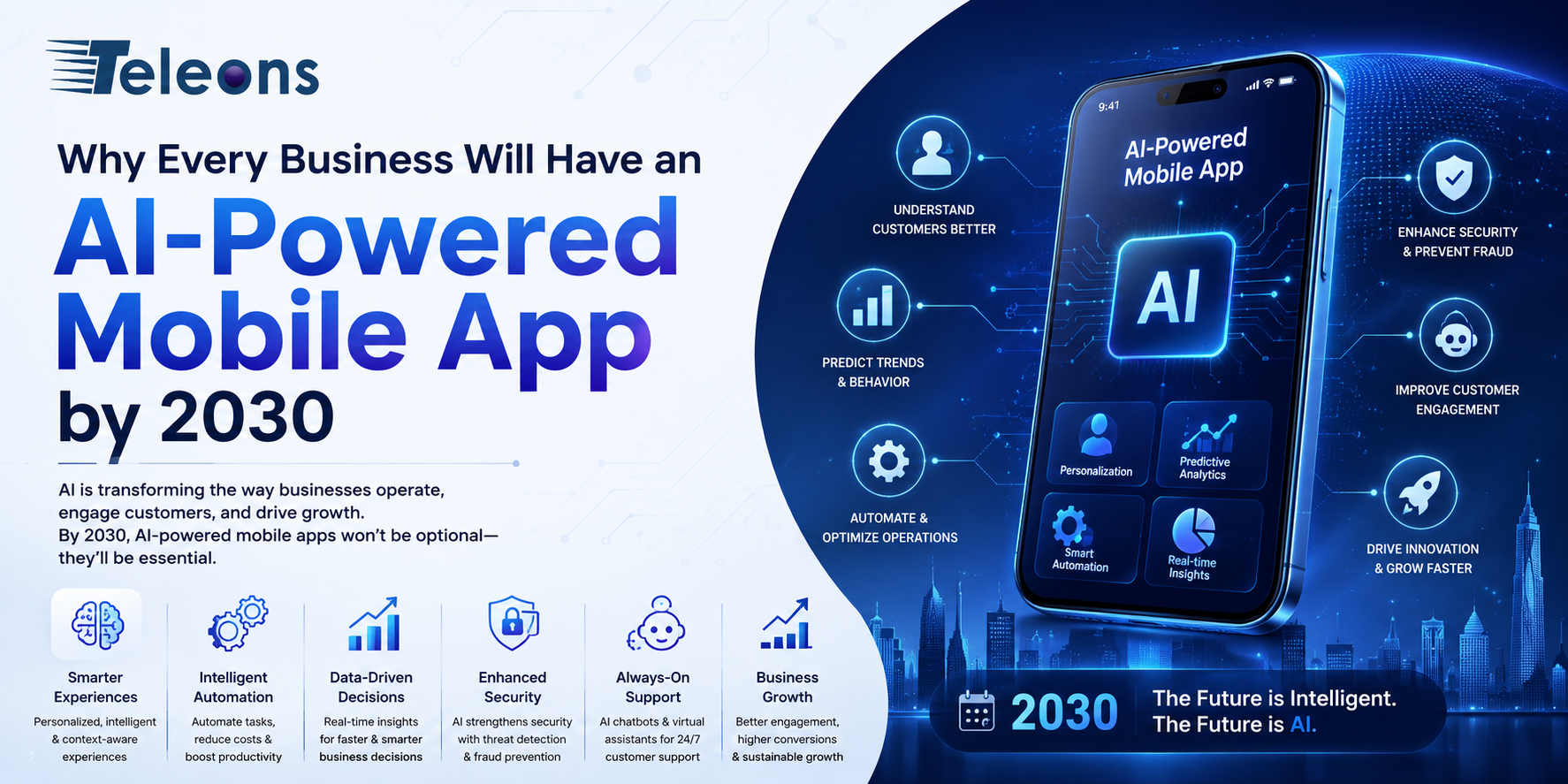
Why Every Business Will Have an AI-Powered Mobile App by 2030
Hyper-Personalized Customer Experiences
Personalization has become a key factor in customer satisfaction. AI analyzes user preferences, browsing history, purchase behavior, and interactions to provide tailored recommendations and customized content.
Examples include:
Personalized product suggestions
Customized offers and discounts
Individualized content feeds
Location-based recommendations
Benefits
Higher customer engagement
Increased sales
Improved customer loyalty
Better user retention
24/7 AI-Powered Customer Support
Modern customers expect instant assistance at any time of the day. AI chatbots and virtual assistants provide round-the-clock support by answering questions, resolving issues, scheduling appointments, and processing requests without human intervention.
Benefits
Faster response times
Reduced support costs
Improved customer satisfaction
Consistent user experience
Smarter Business Decisions Through Data Analytics
AI processes vast amounts of business data to uncover valuable insights. It identifies patterns, predicts customer behavior, and helps businesses make informed decisions.
Businesses can use AI to:
Forecast sales
Predict demand
Analyze customer preferences
Improve marketing strategies
Optimize inventory management
Increased Business Automation
AI automates repetitive and time-consuming tasks, allowing employees to focus on strategic activities.
Common automation features include:
Appointment scheduling
Order processing
Customer support
Invoice generation
Data entry
Notifications
Automation improves efficiency while reducing operational costs.
Voice Search and Virtual Assistants
Voice technology is becoming increasingly popular. AI-powered mobile apps integrate voice assistants that allow users to perform tasks through voice commands.
Applications include:
Product searches
Navigation
Banking transactions
Healthcare consultations
Smart home control
Voice-enabled apps improve accessibility and convenience.
Predictive Analytics
AI helps businesses anticipate customer needs before they arise by analyzing historical and real-time data.
Predictive analytics can:
Recommend products
Predict customer churn
Estimate future sales
Detect buying trends
Optimize pricing strategies
Businesses can proactively improve customer experiences instead of reacting after problems occur.
Enhanced Security and Fraud Detection
Cybersecurity has become a major concern for businesses.
AI improves security by:
Detecting suspicious activities
Preventing fraudulent transactions
Monitoring login behavior
Identifying unusual user patterns
Strengthening authentication
This helps protect sensitive customer and business data.
Better User Engagement
AI continuously learns from user interactions and adapts app experiences accordingly.
Features include:
Personalized notifications
Smart reminders
Dynamic content
Behavioral recommendations
Loyalty rewards
Engaged users spend more time within the app and are more likely to become repeat customers.
Real-Time Language Translation
Businesses increasingly serve customers across different countries and languages.
AI-powered translation features allow users to communicate seamlessly, making apps more accessible to a global audience.
Competitive Advantage
Businesses adopting AI gain a significant competitive advantage by offering innovative features that improve customer experiences.
Companies with AI-powered apps can:
Respond faster
Reduce operational costs
Improve customer satisfaction
Increase revenue
Build stronger brand loyalty
Industries That Will Benefit from AI-Powered Mobile Apps
Healthcare
AI symptom checkers
Appointment scheduling
Remote patient monitoring
Medical record analysis
E-commerce
Personalized shopping
Product recommendations
Smart search
AI customer support
Banking & Finance
Fraud detection
Financial planning
AI assistants
Automated customer service
Education
Personalized learning
AI tutors
Progress tracking
Intelligent assessments
Real Estate
Virtual property tours
AI recommendations
Property valuation
Lead management
Travel & Hospitality
Smart itinerary planning
Travel recommendations
AI booking assistants
Personalized travel experiences
Retail
Inventory forecasting
Customer analytics
Smart checkout
Dynamic pricing
Key AI Technologies Powering Mobile Apps
Machine Learning (ML)
Natural Language Processing (NLP)
Computer Vision
Generative AI
Predictive Analytics
Recommendation Engines
Speech Recognition
Facial Recognition
Sentiment Analysis
Robotic Process Automation (RPA)
Challenges of AI-Powered Mobile Apps
Although AI offers significant benefits, businesses should also consider potential challenges:
High initial development costs
Data privacy and security concerns
AI model training requirements
Ongoing maintenance
Regulatory compliance
Ethical AI implementation
Need for high-quality data
Working with an experienced mobile app development company helps overcome these challenges.
Future Trends in AI Mobile App Development
By 2030, AI-powered mobile apps are expected to include:
Autonomous AI agents
Emotion-aware user interfaces
Hyper-personalized experiences
AI-generated content
Predictive healthcare solutions
Advanced voice assistants
AI-powered cybersecurity
Augmented Reality (AR) with AI
Internet of Things (IoT) integration
Edge AI for faster processing
These innovations will redefine how businesses engage with customers and manage operations.
Why Choose Teleons for AI Mobile App Development?
At Teleons, we build intelligent, scalable, and secure AI-powered mobile applications tailored to your business goals. Our team combines expertise in AI, machine learning, and mobile technologies to create innovative apps that enhance user experiences and drive business growth.
Whether you’re a startup, SME, or enterprise, we help you transform your ideas into future-ready mobile solutions.
Build the Future with AI-Powered Mobile Apps from Teleons
Ready to transform your business with intelligent mobile technology?
Teleons specializes in designing and developing custom AI-powered mobile applications that enhance customer experiences, automate workflows, and accelerate business growth.
From AI chatbots and predictive analytics to personalized user experiences and scalable cloud solutions, our experts create innovative apps tailored to your unique business needs.
Partner with Teleons today to develop a future-ready AI mobile app that keeps your business competitive in the digital era.
Phone: +91-99-6705-4979
Mail: sales@teleons.com
Address: Vile Parle, Mumbai 400057
Conclusion
AI-powered mobile apps are rapidly becoming an essential part of modern business strategy. They enable organizations to deliver personalized customer experiences, automate operations, improve decision-making, enhance security, and stay competitive in an increasingly digital world.
As we move toward 2030, businesses that invest in AI-powered mobile applications today will be better prepared for tomorrow’s challenges and opportunities. Adopting AI is no longer just about innovation—it’s about creating smarter, more efficient, and customer-centric experiences that fuel long-term success.
FAQs
1. What is an AI-powered mobile app?
An AI-powered mobile app uses technologies like machine learning, natural language processing, and predictive analytics to automate tasks, personalize user experiences, and make intelligent decisions.
2. Why are AI-powered mobile apps important for businesses?
They improve customer engagement, automate processes, enhance security, provide valuable insights, and help businesses deliver better user experiences.
3. Which industries benefit most from AI-powered mobile apps?
Healthcare, retail, e-commerce, finance, education, travel, logistics, real estate, and manufacturing all benefit significantly from AI integration.
4. Can AI improve customer support in mobile apps?
Yes. AI chatbots and virtual assistants provide instant, 24/7 customer support, answer common queries, and improve response times.
5. Are AI-powered mobile apps secure?
When built with proper security measures, AI apps can enhance security through fraud detection, biometric authentication, and real-time threat monitoring.
6. Is AI app development expensive?
The cost depends on the app’s complexity, AI features, integrations, and customization requirements. While the initial investment may be higher, AI often reduces long-term operational costs and increases ROI.
7. What AI features should businesses include in their mobile apps?
Popular features include AI chatbots, recommendation engines, predictive analytics, voice search, image recognition, personalized notifications, and fraud detection.
8. Why should businesses invest in AI-powered mobile apps before 2030?
Early adoption helps businesses gain a competitive advantage, improve customer satisfaction, automate operations, and stay ahead of rapidly evolving market expectations.


Related Posts
App Store Optimization: How to Get More App Downloads
Building a mobile app is only the first step. The next challenge is getting people to discover, download and use it. With thousands of apps…
Read More
How Mobile Apps Help Businesses Improve Customer Engagement
Introduction Customer engagement has become a critical factor in building a successful business. Customers today expect brands to be accessible, responsive, personalized, and convenient across…
Read More